Courses
If you are an HR leader in 2026, you are likely exhausted by the “AI hype cycle.” Over the past three years, you’ve been sold on Generative AI chatbots that promised to revolutionize your department, only to find that they essentially function as glorified, prompt-dependent document drafters.
Your frustration is valid. Generative AI was just the prologue. The actual transformation arriving at enterprise scale today is Agentic AI.
In most HR teams we work with, the shift is already visible in the way AI quietly handles approvals, reminders, and routing in the background. We are moving from human-prompted tools to autonomous Agentic HR Systems—digital teammates that continuously observe, reason, and execute multi-step workflows across fragmented tech stacks without waiting to receive instructions what to do.
In HR, agentic AI means AI agents that act as digital HR teammates, monitoring data, deciding next best actions, and executing workflows across your HR tools without waiting for prompts.
This guide explains what agentic AI means for Human Resources, what is agentic AI in HR, how agentic AI is used across the HR lifecycle, how to evaluate agentic AI vendors, how Agentic HR Systems differ from chatbots and RPA, the architectural blueprints you need to understand, and how to safely orchestrate these systems while being compliant with the EU AI Act and GDPR.
And if you are looking ways to implement this successfully consider learning about Agile HR Mindset and Principles. Agile HR acts as the operating system to plan, develop, check and adapt any AI deployment in HR with higher chances to achieving successful business outcomes.
1. Generative AI vs Agentic AI in HR: The 2026 Paradigm Shift
To dominate the future of talent, HR teams must understand the distinction between generating content and executing workflows.
- Generative AI (The Assistant): Reacts to your query. You ask it to write a job description, and it generates text. It requires a human to initiate the action, validate the output, and manually move that output into an ATS. (Note: If you are still mastering GenAI, start with our foundational 50 HR Prompt Library to speed up your drafting).
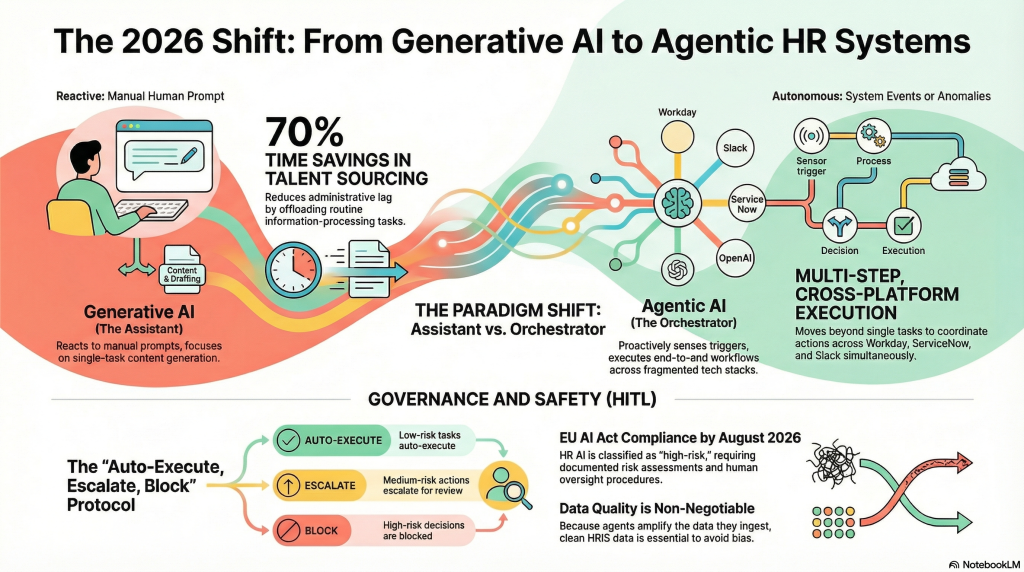
- Agentic AI in HR (The Orchestrator): Acts with autonomy. It senses a trigger, plans a series of actions, and executes them across multiple HR systems and tools.
The 2026 Reality for Agentic AI in HR: Generative AI waits for a human to ask a question. Agentic AI continuously monitors workforce signals—like declining engagement, stalled recruitment pipelines, or payroll anomalies—and takes autonomous action to resolve them across systems like Workday, ServiceNow, and Slack.
The Capability Comparison of Generative AI in HR vs Agentic AI in HR
| Feature | Generative AI in HR | Agentic HR Systems |
|---|---|---|
| Trigger | Manual (Human prompt) | Autonomous (System event, signal, or anomaly) |
| Primary Function | Content creation & summarization | End-to-end workflow execution & problem solving |
| Scope | Single task, single system | Multi-step, cross-platform orchestration |
| Value Proposition | Saves time on drafting | Re-architects how HR work is done |
| Relation to RPA / Chatbots | Static flows, rule-based, prompt-driven | Dynamic, goal-driven agents that plan, act, and adapt |
2. ROI of Agentic AI in HR: What the Data Says
The operational impact of Agentic HR Systems is no longer theoretical—it is already reshaping how HR operates. By offloading complex, multi-step workflows to autonomous agents, HR eliminates the administrative lag that traditionally separates business reality from HR intervention.
According to a landmark 2025 study on the Future of Work with AI Agents (Shao et al., Stanford University), AI agents are absorbing routine “information-processing” tasks so that human value shifts toward interpersonal and organisational skills. As agents take care of orchestration, HR professionals spend more time on high-agency work such as culture building, conflict resolution, and strategic workforce design.
When you pair this shift in capability with efficiency metrics—such as PwC’s 2025 data indicating that agentic solutions can save hiring professionals up to 70% of their time on talent sourcing—the ROI becomes clear: HR moves from an “administrative overhead” function to a predictive intelligence hub that prevents issues instead of reacting to them.
3. Agentic HR System Architecture: The 4 Building Blocks
You do not need to be a software engineer to buy or deploy these systems, but you must understand their anatomy to evaluate vendors accurately. A true Agentic HR System is built on four distinct layers:
3.1 Context Layer in Agentic HR Systems (Perception in HR Data)
This layer ingests real-time information and data from your ecosystem (e.g., Greenhouse, Workday, Microsoft Teams, learning platforms, surveys) to understand the current state of your workforce. It continuously updates the “people graph” of roles, skills, events, and risks.
3.2 Reasoning Layer for Agentic AI in HR (Cognition over HR Policies)
This layer uses Large Language Models (LLMs) and other AI techniques to analyse context and plan multi-step workflows based on your organisation’s policies, playbooks, and risk appetite. It turns HR policies into machine-readable decision logic.
3.3 Execution Layer for Agentic AI in HR (Action Across HR Workflows)
Here, the agent triggers APIs and integrations to take action—posting jobs, updating HRIS records, scheduling calendar invites, raising tickets, or sending personalised nudges to managers and employees.
3.4 Governance Layer for Agentic HR Systems (Safety, HITL and Compliance)
This is the compliance and control safeguard that dictates which decisions an agent can make autonomously and which require human approval. It encodes Human-in-the-Loop (HITL) rules, logging, approvals, and guardrails for high-risk HR decisions.
4. Agentic AI in HR: Use Cases Across the Employee Lifecycle
Agentic AI in HR is most powerful when you design agents around specific outcomes across the employee lifecycle. Below are practical agentic AI examples HR teams are already piloting in 2026.
4.1 Agentic AI in Talent Acquisition and Recruiting
- Creating job descriptions from workforce plans and skills frameworks.
- Sourcing and screening candidates across multiple platforms, then ranking them against defined skill and culture rubrics.
- Coordinating interview scheduling, reminders, and feedback collection for hiring panels.
- Managing background checks and offer workflows across HR, legal, and finance.
4.2 Agentic AI for Onboarding and Internal Mobility in HR
- Automatically provisioning access, equipment, and learning journeys when an offer is marked as accepted.
- Coordinating cross-functional tasks across HR, IT, facilities, finance, and line managers.
- Identifying internal candidates for open roles and recommending internal moves before external hiring.
4.3 Agentic AI for Learning, Skills and Capability Development
- Mapping employees’ current skills to role and project requirements.
- Recommending personalised learning paths and mentoring based on skills gaps and career goals.
- Tracking completion, impact, and readiness for lateral moves or promotions.
4.4 Agentic AI for Performance, Rewards and Workforce Insights
- Flagging patterns in performance and feedback data, such as teams with declining engagement or rising attrition risk.
- Supporting performance cycles by orchestrating reminders, calibration inputs, and documentation collection.
- Alerting HR and finance when new regulations or cost changes affect workforce plans or reward structures.
4.5 Agentic AI for Employee Support and Employee Relations
- Answering policy questions and guiding employees through processes such as leave, benefits, and flexible work requests.
- Triaging employee relations issues, routing cases to the right HR partner, and maintaining a documented trail.
- Proactively surfacing hotspots where interventions, coaching, or mediation may be needed.
5. Real‑World Examples of Agentic AI in HR (Multi‑Agent Orchestration)
In 2026, we don’t just use one AI; we use a “swarm” of specialised agents working together around shared HR goals. We highly recommend deploying these agents using an iterative, fail-fast approach like our Agile HR S.P.R.I.N.T. Framework so you can learn safely and course-correct quickly.
5.1 The Autonomous Recruiting Engine: Agentic AI for Talent Acquisition
Recruiting is an orchestrated ecosystem. An agentic workflow can parse a resume, score it semantically against hidden skill adjacencies, and automatically route top candidates to hiring managers while handling calendar negotiations. In one mid-sized organisation we worked with, this type of recruiting agent cut time-to-slate by several days and freed recruiters to focus on deeper candidate conversations.
5.2 Agentic AI for Onboarding: Functional Fluidity Across HR, IT and Finance
A single Onboarding Agent recognises when an offer is signed in the ATS, provisions software licences via IT’s ticketing system, sets up payroll profiles in Finance, and messages the new hire’s manager in Slack with a 30-day integration plan. In practice, this reduces manual handoffs and prevents “day one” surprises such as missing access or incomplete paperwork.
5.3 Agentic AI for Learning and Development Orchestration
Continuous learning is another area where agentic AI shines. A Learning Agent can monitor mandatory training, nudge employees before deadlines, recommend stretch assignments based on skills, and give HR an up-to-date view of capability gaps across markets.
5.4 Risks of Agentic AI in HR (and How to Avoid Them)
- “Shadow agents” with no owner: Pilots launched without clear governance, leading to duplicated logic and inconsistent behaviour.
- Over-automation of sensitive decisions: Agents making high-stakes calls (e.g., terminations) without sufficient review.
- Data quality blind spots: Agents amplifying bias or errors because underlying HR data was never cleaned or validated.
Each of these failure modes is avoidable if you deliberately design HITL controls, assign an “AI steward” role, and treat Agentic HR Systems as part of your operating model—not just as tools.
6. Compliance and Governance for Agentic AI in HR (EU AI Act and GDPR)
Search engines, regulators, and boardrooms all demand the same thing: trust. As the EU AI Act classifies many HR AI applications as “high-risk,” deploying autonomous agents without a safety net is a massive legal and reputational liability.
6.1 Human‑in‑the‑Loop (HITL) Framework for Agentic HR Systems
Autonomy without accountability is reckless. To deploy Agentic HR Systems safely, organisations must implement an Operational HITL framework:
- Auto-Execute: Low-risk, reversible actions (e.g., answering PTO policy questions, sending reminders, updating non-sensitive records).
- Escalate: Medium-risk actions requiring human review (e.g., flagging a “flight risk,” suggesting a shortlist, recommending talent moves).
- Block: High-risk actions requiring explicit human sign-off (e.g., final hiring decisions, promotions, performance ratings, terminations).
6.2 EU AI Act and HR: What Agentic AI Deployers Must Know by 2026
Under the EU AI Act, most AI systems used for recruitment, worker management, and access to employment are treated as high-risk by default. This covers tools that screen candidates, rank applications, support promotion decisions, or profile employees for risk or potential.
By August 2, 2026, employers deploying these systems in the EU must ensure that high-risk AI used in HR meets strict obligations around risk management, data governance, technical documentation, accuracy, robustness, and human oversight. Providers have to complete conformity assessments and register high-risk systems, but employers as deployers remain responsible for how AI is used in their HR processes.
In practice, this means HR, Legal, IT, and Works Councils need to work together on:
- Documented risk assessments (including Data Protection Impact Assessments under GDPR for high-risk HR AI).
- Clear human oversight procedures, including HITL criteria and escalation paths.
- Transparency to employees and candidates that AI is being used in decisions affecting them.
- Regular monitoring, logging, and audits to detect bias, drift, or unintended harm.
6.3 HR Agentic AI Governance Checklist (2026)
- Inventory where AI and agents already operate in your HR tech stack.
- Classify which use cases count as high-risk under the EU AI Act and similar regulations.
- Define “Auto-Execute / Escalate / Block” rules for each agent.
- Appoint an AI steward or committee with clear accountability.
- Train HR, managers, and employee representatives on what agentic AI does—and what it does not do.
7. How HR Leaders Should Evaluate Agentic AI Vendors in 2026
Choosing an agentic AI vendor is not just a feature comparison; it is a decision about how work will be done in your HR function for years. When evaluating Agentic HR Systems, go beyond demos and ask concrete questions.
- Data & skills model: How does the system represent people, roles, and skills? Can you bring your own skills framework?
- Governance & EU AI Act readiness: How does the vendor support risk management, documentation, and human oversight obligations?
- Integrations: Which ATS, HRIS, collaboration, and ticketing tools are supported out of the box?
- Explainability: Can HR and managers see why the agent made a recommendation or took an action?
- Pilot support: Does the vendor provide playbooks, change management support, and success criteria for your first pilots?
Agents change the operating model of HR. Treat vendor evaluation as an operating model decision, not a “nice-to-have” add-on to your existing tech stack.
8. How to Implement Agentic AI in HR: Roadmap from Pilot to Scale
You do not have to “agentise” your entire HR function at once. In fact, the most successful HR teams in 2026 follow an agile, experiment-driven roadmap.
Step‑by‑Step Agentic AI Implementation Plan for HR Teams
- Clarify outcomes: Start with 1–2 outcomes (e.g., reduce time-to-hire, improve onboarding experience, reduce HR ticket backlog).
- Choose pilot workflows: Pick high-volume, rule-based workflows with clear boundaries and measurable metrics.
- Design HITL upfront: Define what the agent can do alone, what needs review, and what remains human-only.
- Run a limited pilot: Use a small population or one business unit. Observe failure modes and refine.
- Scale with S.P.R.I.N.T.: Use our Agile HR S.P.R.I.N.T. Framework to iterate, extend to new use cases, and embed agentic ways of working.
By treating Agentic HR Systems as part of your agile transformation—not a separate “AI project”—you build internal capability and trust while staying safely inside regulatory boundaries.
Contact Us to discuss how to implement what we discussed above and we are happy to help.
9. Agentic AI in HR: Frequently Asked Questions (FAQ)
Q: What is agentic AI in HR in simple terms?
A: Agentic AI in HR refers to autonomous or semi-autonomous AI “agents” that can monitor signals, make plans, and execute multi-step HR workflows across tools like your ATS, HRIS, and collaboration platforms. Instead of waiting for prompts, these agents act on goals and policies you define.
Q: How is agentic AI different from Generative AI in HR?
A: Generative AI (like chatbots and co-pilots) is reactive and prompt-based; it helps draft content such as emails, job descriptions, and policies. Agentic AI is autonomous, proactive and workflow-based. It operates autonomously to conduct complex, multi-step workflows (like sourcing candidates, evaluating skills, and scheduling interviews) with minimal human involvement.
Q: What are the best early pilot use cases for Agentic HR?
A: Start with high-volume, logic-based workflows that already rely on digital systems. The most successful 2026 pilot areas include recruitment coordination (interview scheduling, background checks), onboarding orchestration (cross-system provisioning), and Tier 1 employee support (benefits Q&A paired with automated ticket resolution).
Q: What data do we need in place before deploying Agentic HR Systems?
A: At a minimum, you need reasonably clean HRIS data (roles, locations, managers), well-defined workflows and policies, and clarity on your skills framework if you plan to use agents for talent, learning, or internal mobility. Agents amplify whatever data you feed them, so investing in data quality is non-negotiable.
Q: Will Agentic AI replace HR professionals?
A: No. Agentic AI is designed to replace tasks, not roles. By eliminating repetitive administrative load, it frees HR teams to focus on high-value, human-centric work: strategic workforce planning, compassionate leadership coaching, culture, and complex conflict resolution.
Q: How does agentic AI relate to RPA (Robotic Process Automation) and traditional HR automation?
A: RPA and traditional automation follow fixed, rule-based scripts. Agentic AI uses LLMs and other models to interpret context, set goals, and adapt workflows in real time. You can think of agentic AI as “adaptive automation” that can learn from outcomes and work across a broader range of HR processes.
Q: Is Agentic AI compliant with regulations such as the EU AI Act and GDPR?
A: It can be, but compliance is not automatic. HR leaders must deploy systems with strict governance guardrails. This includes implementing Human-in-the-Loop (HITL) controls for critical and important decisions, conducting regular algorithmic bias and impact assessments, informing workers when high-risk AI is used, and ensuring all AI data usage relies on explicit consent, lawful basis, and clear retention rules.
Q: What skills do HR teams need to work effectively with AI agents?
A: The critical skills include data literacy, process design, change management, and comfort working with AI-generated insights. HR business partners do not need to become coders, but they do need to understand how agents are configured, what data they use, and how to challenge or override suggestions when necessary.
Q: How do we explain agentic AI to employees and candidates?
A: Be transparent and plain-spoken. Explain what the agent does (e.g., helps schedule interviews faster), what it doesn’t do (e.g., make final hiring decisions), how people can ask questions, and how you protect privacy and fairness. Transparency builds trust and reduces fear around new AI-enabled ways of working.

Bhavna is an Agile Coach and Consultant with 15+ years of experience in advisory, corporate finance, IT assurance, and operations at Big 4 and within the industry in the UK and India. She has recently been the CEO of a start-up where she implemented agile practices within HR, Marketing, and Product teams.
She is also a SAFe® Practice Consultant (SPC) and authorized instructor for ICAgile Agility in HR (ICP-AHR), Agility in Marketing (ICP-MKG), and Business Agility Foundations (ICP – BAF) training courses. She provides training for agile transformation to corporate, public, and private batches, as well as consulting for enterprise agile transformation.
![Best AI Chatbots for Agile Teams [2025]](https://www.valuex2.com/wp-content/uploads/2025/03/Best-AI-Chatbots-for-Agile-Teams-2025-01-150x150.jpg "Best AI Chatbots for Agile Teams 2025")