Courses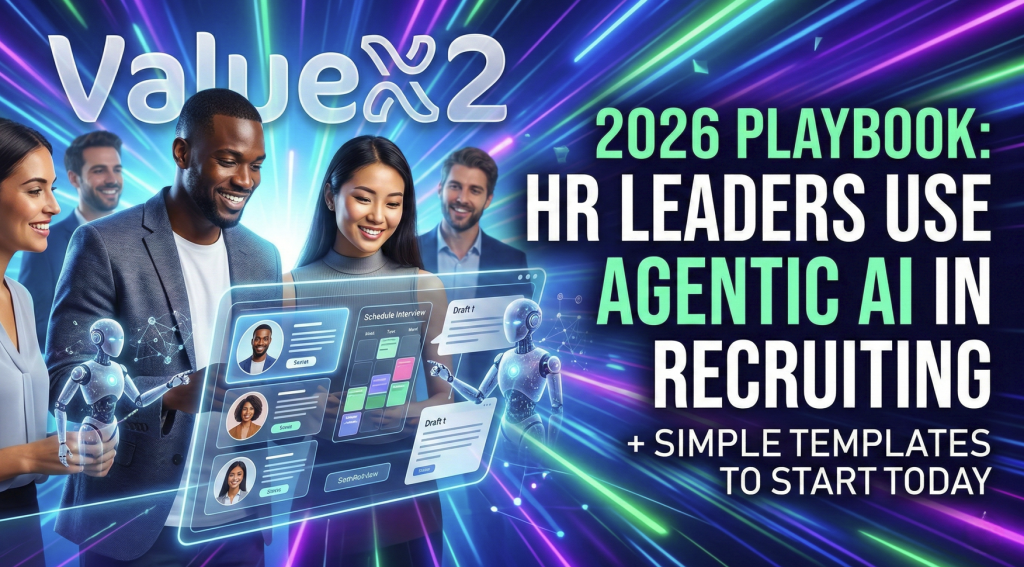
Executive Summary
Agentic AI in recruiting refers to autonomous AI agents that manage end-to-end talent workflows—from sourcing and screening to scheduling and feedback—while operating under strict human-defined rules for fairness and compliance.
This playbook shows HR and TA leaders how to use agentic AI for high-volume, high-friction recruiting work, what must stay human, and how to build practical, low-risk agent workflows you can start piloting this week.
Ready to pilot? Use the copy-paste templates below to brief your tech team or vendor today. Leverage Agile Mindset and Principles while implementing AI in HR. Our Agility in HR Course deep dives into how to successfully move from theory to implementation in 3 days.
Explore ValueX2’s Agentic AI HR Systems Guide
What is Agentic AI in Recruiting?
Agentic AI in recruiting is AI that can sense, decide and act across recruiting tasks – for example, scanning CVs, drafting outreach, scheduling interviews and nudging feedback – with clear goals, policies and oversight.
Unlike a simple chatbot, an agent is built to work through multi-step workflows (e.g., “screen all applications for role X, shortlist 20, schedule interviews, send rejections”) and report back, while logging every step for audit.
In 2026, 68% of TA leaders report using agentic systems for high-volume roles, per SHRM 2026 AI in HR Report, because they cut screening time by 75% without sacrificing quality when governed properly.
According to the Stanford Digital Economy Lab (2025) and PwC Workforce Transformation Report (2026), early adopters achieved:
-
70% faster sourcing turnaround
-
2.3× higher candidate engagement
-
40% lower recruiter burnout
In short, agentic systems recruit continuously—learning, reasoning, and improving with every interaction.
There are many ways in which Agentic AI is disrupting Traditional HR processes.
Agentic AI vs. Traditional Recruiting Tools
| Traditional AI Recruiting (2018-2024) | Agentic AI Recruiting (2026+) |
|---|---|
| Single tasks: resume ranking, scheduling | Full workflows: source → screen → schedule → feedback |
| Prompt-driven: recruiter initiates each step | Autonomous: runs on triggers with human guardrails |
| Minimal logging: hard to audit decisions | Full audit trails: every action timestamped and rule-based |
ValueX2 insight: Agentic AI in recruitment is best for in repeatable, high-friction workflows like customer success or engineering hires, not one-off executive search.
Which Recruiting Workflows Can AI Agents Automate End-to-End?
HR leaders successfully delegate these 4 core workflows to agentic AI while keeping humans in critical judgment roles:
1. Sourcing → Screening → Shortlisting (High-Volume Roles)
Full automation possible: AI Agent reads job req → pulls candidates from ATS/LinkedIn/database → applies must-have filters → scores nice-to-haves → delivers recruiter-approved shortlist with rationale. Human role: Final shortlist approval.
Live Application example – Customer service hiring: 200 applications/week for support roles → agent filters for 2+ years experience + specific CRM skills → delivers 25 qualified candidates with match % scores. Recruiter spends 15 minutes reviewing instead of 8 hours screening.
2. Interview Scheduling + Confirmations
Full automation possible: Agent reads approved shortlist → checks 3 interviewer calendars → proposes 3 time slots to candidates → books confirmed slots → updates ATS → sends all confirmations/reminders. Human role: None required.
Live Application example – Campus hiring: AI Agent coordinates 50 first-round interviews across 3 time zones, reducing scheduling from 12 hours to 30 minutes total recruiter time.
We suggest to start with such implementations first so that you can start seeing benefits more quickly. ValueX2 SPRINT Framework can be used confidently to implement Agentic AI in recruitment systematically.
3. Candidate Communication During Process
Full automation possible: Agent triggers personalized emails at each stage (applied, shortlisted, scheduled, rejected) + answers 80% of FAQ questions. Human role: Escalations only.
Live Application example – High-volume SDR hiring: Agent handles 1,200 candidate status updates/month, answering “when will I hear back?” 400 times while escalating only 15% complex cases to recruiters.
4. Hiring Manager Feedback Collection
Full automation possible: Agent emails interviewers post-loop → collects scores/comments → calculates consensus → flags outliers → escalates to recruiter if overdue. Human role: Resolving disagreements.
Live Application example – Engineering roles: Agent chases feedback from 8 interviewers across 15 candidates, achieving 92% response rate vs previous 47% manual process.
What are Real-World Use Cases for Agentic AI in Recruitment? (What HR Leaders Deploy Today)
Across recent HR and TA reports, AI use is most concentrated in recruitment – sourcing, screening, matching, scheduling and candidate communication. Early agentic AI deployments extend this by letting agents manage whole recruiting “campaigns” for repeatable roles (customer support, fulfilment, SDRs) with human oversight at defined checkpoints.
High-volume frontline roles: Agents manage sourcing, screening and interview scheduling for hundreds of applications per month. This works best when roles have clear, objective criteria (2+ years experience, specific CRM skills, shift availability).
ValueX2 client result: A 3,000-employee SaaS company piloted our agentic screening workflow for Customer Success Manager roles. Screening time dropped from 8 hours to 90 minutes per requisition, with hiring managers reporting 40% higher shortlist quality due to consistent rationale documentation.
Campus/early careers hiring: Agents coordinate outreach across multiple universities, handle screening tasks based on GPA/extracurriculars, and orchestrate virtual interview days. Recruiters focus only on top candidates and relationship building with career services.
Internal mobility and redeployment: Agents continuously match existing employees to open roles before external sourcing begins. They surface “hidden talent” – employees who match 85%+ of requirements but aren’t actively looking.
Candidate care at scale: Agents send personalised updates, answer FAQs, and provide next-step guidance so recruiters can focus on complex conversations while maintaining high candidate satisfaction scores.
What must remain human in recruiting even after implementing Agentic AI
Even with advanced agents, HR leaders consistently draw clear lines on what must stay human. These lines are important for trust, ethics and legal defensibility.
-
Keep the following tasks human‑led:
-
Final hiring decisions, especially for leadership and sensitive roles.
-
Culture and values assessment, particularly live interviews and nuanced conversations.
-
Tailored offers, negotiations and sensitive feedback (rejections for long processes, complex assessments).
-
Escalations relating to discrimination, accessibility or complaints about the hiring process.
Agents should prepare information, streamline workflows and surface risks, but a human should ultimately sign off on high‑stakes decisions.
-
Agent role: Prepare data, flag risks, execute approved actions. Human role: Sign off on judgment calls.
Quick Prioritization Matrix – Which recruitment process should you use agentic AI first?
Surveys and case studies show the best first wins are:
-
High-volume, standardised roles (clear criteria, large applicant pools).
-
Stages with repetitive, rules-based tasks (screening against must‑have criteria, scheduling, reminders).
-
Processes where delay is your biggest pain (e.g., hiring manager feedback, candidate communication).
Use a simple test: if you can explain the task in two sentences of clear rules (e.g., “screen for 3 must‑have skills and 2 nice‑to‑have, reject if any deal‑breakers”), it’s a candidate for an agent.
Which recruitment process should you use agentic AI first?
| High agentic AI ROI | Medium ROI | Keep manual |
|---|---|---|
|
|
|
Top Performing Agentic AI Recruiting Tools in 2026
The transition from “chatbots” to “agents” has led to a clear tier of leaders in the recruitment ecosystem. Below is a comparative analysis of the top-performing tools based on enterprise scalability, ethical AI governance, and user satisfaction ratings from credible peer-review platforms like G2, Software Advice, and Gartner Peer Insights.
| Tool Name | Primary Agentic Use Case | 2026 G2 / Peer Rating | Key Strengths | Best For |
| Eightfold AI | Talent Intelligence & Skills-Based Matching | 4.2 / 5.0 | Deep skills-based “People Graph”; diversity analytics; automated internal mobility. | Global Enterprises with complex skill taxonomies. |
| Paradox (Olivia) | High-Volume Conversational Orchestration | 4.7 / 5.0 | 24/7 autonomous scheduling; SMS-first engagement; handles multi-step onboarding. | Retail, Hospitality, and high-volume hourly hiring. |
| HireVue | Video Intelligence & Automated Scoring | 4.1 / 5.0 | Enterprise-grade compliance (FedRAMP); game-based assessments; bias-mitigated scoring. | Highly regulated industries and graduate recruitment. |
| Beamery | Talent Lifecycle Management & Sourcing | 4.1 / 5.0 | Predictive demand signals; proactive talent pooling; seamless CRM/ATS sync. | Proactive sourcing for technical and niche leadership roles. |
| Textkernel | Multilingual Semantic Sourcing & Parsing | 4.4 / 5.0 | Industry-leading semantic search; identifies “transferable skills” across languages. | Multi-national firms with fragmented external talent data. |
How to Implement an AI Recruiting Agent (The S.P.R.I.N.T. Framework)
To deploy AI Recruiting Agent responsibly, ValueX2 recommends the S.P.R.I.N.T. governance model:
-
S — Scope the Outcome: Identify high-volume, low-empathy tasks (e.g., initial technical screening).
-
P — Prepare the Foundation: Audit your skill taxonomy and check historical data for hidden biases.
-
R — Reason and Plan: Select an enterprise-grade model that provides “Step-by-Step” reasoning logs.
-
I — Integrate and Execute: Connect to your ATS/CRM using permission-aware APIs.
-
N — Notify and Govern: Implement human-in-the-loop (HITL) checkpoints for final shortlist approvals.
-
T — Track and Tweak: Conduct quarterly “Drift Audits” to ensure the agent’s logic remains aligned with company culture.
Step-by-step: build your first agentic AI recruiting workflow (in 30–60 minutes)
This section is designed so a TA leader and a tech partner (internal or external) can map a pilot workflow today and brief IT or a vendor tomorrow.
1. Choose one workflow
Pick one role or workflow where you have:
-
High volume (or frequent repeat)
-
Clear, objective criteria
-
A cooperative hiring manager
Examples: customer support agents, retail associates, inside sales reps, standard engineer profiles.
Write it as:
“Agent will manage [workflow] for [role] in [location], up to [N] candidates per month, under [constraints].”
Example: “Customer Success Agent hiring in EMEA, 50+ apps/week.”
2. Define the agent’s mission and guardrails – Agent Brief
Write a short “agent brief” any non‑technical stakeholder can understand:
-
Goal: “Shortlist the 20 most suitable candidates for Role X each week, schedule first‑round interviews, and update the ATS.”
-
Inputs: job description, required skills, CVs/profiles, calendar access, ATS access (read/write boundaries).
-
Allowed actions: read candidate data, score profiles, send templated emails, propose interview times, update status fields.
-
Forbidden actions: change compensation bands, send offers, alter job requirements, modify DEI/EEO fields.
-
Oversight: “No candidate is rejected solely by the agent; a recruiter reviews all final rejections for borderline cases.”
3. Map the workflow as explicit steps
Use a simple, text-only flow that can be turned into an agent graph by your tech team or vendor:
-
Trigger: New requisition approved in ATS for Role X.
-
Extract criteria: Agent reads the requisition and extracts must‑have and nice‑to‑have criteria.
-
Agent pulls candidates from:
-
New applications
-
Internal talent pool
-
Past silver medalists.
-
-
Screens: Agent screens candidates:
-
Filters out those missing any must‑have criteria.
-
Scores remaining candidates on nice‑to‑haves.
-
-
Shortlist: Agent drafts shortlist of top N candidates, with rationale per candidate.
-
Human Review: Recruiter reviews shortlist, edits if needed, and approves.
-
Outreach: Agent sends personalised outreach to approved candidates and proposes interview slots.
-
Book and Confirm: Agent books slots, updates ATS statuses, and sends confirmations.
-
Nudge: Agent reminds hiring managers to submit feedback within X days and escalates to recruiter if overdue.
This is enough detail for a vendor or internal developer to implement an agent in many agentic AI platforms.
Proven in practice: One ValueX2 client running this exact flow saw “time-to-shortlist” improve 73% in Week 3 after adding the borderline reject escalation—catching 12% more diverse candidates that pure automation filtered out.
4. Build bias and compliance checks into the flow
At a few key steps, add explicit compliance checks:
-
Screening rules: Document objective criteria and ensure they don’t proxy for protected characteristics.
-
Fairness monitoring: Periodically sample rejections and shortlists for different demographic groups (where legally allowed) to detect patterns.
-
Human review: Require a recruiter to review all rejections that are “borderline” rather than clear fails.
-
Logging: Ensure every agent decision and message is logged with time, rule, and data source for potential audits.
5. Run a 4–6 week pilot
Define success before you start:
-
Time‑to‑screen: reduce manual screening time per candidate by X%.
-
Time‑to‑schedule: reduce the average time between “approved shortlist” and “interview scheduled.”
-
Candidate experience: maintain or improve candidate satisfaction metrics (CSAT, NPS, or post‑process survey).
-
Quality: maintain or improve offer‑acceptance rate and hiring manager satisfaction.
Run the agent on only a subset of roles or locations initially, and keep a “control group” where recruiters work as usual so you can compare.
There is ample benefit if implemented well, “Agentic AI cuts time-to-hire by 62% in volume hiring“
Copy-Paste Agent Templates (Ready to Deploy Today)
How to implement these templates in 3 steps:
- Copy the MISSION statement into your vendor RFP, Zapier workflow, or dev brief
- Replace [bracketed items] with your role-specific details (skills, volume, location)
- Deploy in shadow mode first – agent suggests actions, human approves all outputs
Template 1: Screening + Shortlisting Agent
MISSION: Screen all incoming applications for [Role X], shortlist top 30 per week, flag legal/work eligibility issues
INPUTS: Job req, ATS read/write access, LinkedIn Recruiter
API RULES: Must-have: [3yr exp, SQL, EU work rights]. Nice-to-have: [Salesforce, leadership exp]
OUTPUT: Ranked shortlist + reject log to recruiter dashboard
HUMAN APPROVAL: All shortlists before outreach
Template 2: Interview Scheduling Agent
MISSION: Schedule first-round interviews within 48hrs of shortlist approval
INPUTS: Recruiter-approved shortlist, 3 interviewer calendars, candidate timezones
ACTIONS: Propose 3 slots → send Calendly links → book confirmed slots → update
ATS NOTIFICATIONS: Candidate + interviewer confirmations + 24hr reminders
Template 3: Feedback Collection Agent
MISSION: Collect interviewer feedback within 48hrs post-loop
TRIGGER: Interviews completed >24hrs ago without feedback
ACTIONS: Email interviewers → scorecards → calculate consensus → flag outliers
ESCALATION: No response in 24hrs → recruiter + hiring manager
Bias, fairness and legal defensibility
Regulators and professional bodies are increasingly focusing on automated decision‑making in HR, particularly in recruitment.
HR leaders need patterns, documentation and oversight, not blind trust in vendors’ “ethical AI” claims.
Build your approach around four pillars:
-
Transparency: Document what the agent does, what it doesn’t do, and how decisions are made.
-
Consent and privacy: Ensure candidate data is used within agreed purposes, retained for defined periods, and handled under applicable data protection laws.
-
Bias monitoring: Run regular audits comparing outcomes across groups, adjust models or rules if patterns appear.
-
Human accountability: Make clear in policy that humans (not agents) are responsible for final decisions, and train teams accordingly.
Questions to ask agentic AI recruiting vendors
When evaluating tools claiming to offer agentic AI for recruiting, HR leaders should probe the following:
- “Which recruiting workflows does your agent automate end‑to‑end, and which steps remain manual?”
- “What data does your system use to make decisions, and can we review and change the rules?”
- “How do you test for and monitor bias across different groups?”
- “What audit logs are available if we face a challenge or legal question?”
- “Can we enforce human‑in‑the‑loop approval on rejections, shortlists, or role changes?”
- “How do you handle data retention, candidate rights requests, and deletion?”
HR leaders need both technical governance and agile mindset. ValueX2’s ICAgile Agility in HR certification teaches teams to operationalize these compliance patterns at scale.
4-week audit plan: Week 1: Document rules. Week 2: Run shadow mode. Week 3: Compare agent vs human shortlists. Week 4: Adjust rules.
Metrics and ROI: how to know if agentic AI is working
To justify expansion beyond pilots, you need clear, agreed‑upon metrics. Balance efficiency with quality and fairness so you don’t optimise for speed at the expense of candidate experience or diversity.
Track at least:
-
Process metrics: time‑to‑screen, time‑to‑schedule, recruiter hours saved per role.
-
Quality metrics: pass‑through rates at each stage, offer acceptance, performance at 6–12 months.
-
Candidate experience: satisfaction scores, complaint rates, dropout rates by stage.
-
Fairness metrics: representation at each stage, adverse impact indicators where legally permitted.
Real client outcome: ValueX2 clients tracking “hiring manager CSAT” saw scores jump from 6.8 to 8.9/10 after agentic scheduling freed managers from 4+ hours/week of calendar coordination.
To quantify impact, track three ROI pillars:
-
Efficiency Metrics: Time‑to‑shortlist, recruiter load reduction, sourcing cost per hire.
-
Experience Metrics: Candidate engagement rates, personalization satisfaction, recruiter NPS.
-
Governance Metrics: Explainability score (traceable vs. opaque decisions) and compliance audit outcomes.
Example ROI Model:
After 6 months of deployment, a mid‑enterprise HR team using agentic sourcing observed a 42% drop in cost‑per‑qualified‑candidate and improved demographic diversity by 18%, while maintaining 100% transparency logs.
Advanced Agentic AI in HR Applications
Chaining agentic AI across recruiting, onboarding and internal mobility
Recruiting → Onboarding → Retention
Leading organisations are beginning to connect agents across recruiting, onboarding and internal mobility so talent journeys feel continuous.
For example, the same candidate agent that handled outreach and interviews can hand off to an onboarding agent to coordinate documents, training and early feedback, and later support internal role matching. Another examples is one candidate agent hands off to onboarding agent, which feeds internal mobility agent.
Before you chain agents:
-
Ensure each agent’s scope and guardrails are documented and non‑overlapping.
-
Align data schemas so candidate/employee data remains consistent and governed.
-
Keep humans in the loop at each major transition (offer, onboarding completion, internal moves).
Example Advanced Agentic AI
- The “Hire-to-Productivity” Chain
In this scenario, a “Recruiting Agent” doesn’t just stop at the offer; it triggers a downstream “Provisioning Agent” and a “Culture Agent.”
- Step 1 (Recruiting Agent): Upon the digital signature of an offer letter in the ATS (e.g., Greenhouse), the agent notifies the team in Slack and instantly updates the candidate status to “Hired.”
- Step 2 (The Handoff): The Recruiting Agent pings the Provisioning Agent. This agent automatically checks the new hire’s role (e.g., “Senior Data Engineer”) and sends API commands to IT to provision a MacBook, a GitHub Enterprise seat, and access to specific AWS buckets.
- Step 3 (The Culture Agent): Simultaneously, the Culture Agent identifies the new hire’s designated “Onboarding Buddy” by analyzing team workload data and calendars. It sends the buddy a personalized briefing on the new hire’s background and suggests a “Day 1” lunch spot based on both parties’ locations.
Is Agentic AI Compliant with the EU AI Act and GDPR in 2026?
Yes, but compliance is structural, not optional. As of August 2, 2026, AI systems used for recruitment are classified as “High-Risk” under the EU AI Act.
Core Obligations for HR Leaders:
-
Explainability: The system must provide a “Reasoning Log” for every candidate it ranks.
-
Human Oversight: The Act requires that high-risk AI be designed so that trained personnel can intervene or override any decision. EU AI Act High-Risk Guidelines for HR – “Mandatory human oversight + audit logging”
-
Transparency: Candidates must be clearly informed when they interact with an AI agent.
-
Data Quality: Deployers must ensure input data is relevant and representative to prevent the perpetuation of historical biases.
Agentic AI in Recruiting FAQs for HR and TA Leaders
1. Is agentic AI recruiting legal and compliant?
Yes, when implemented correctly. The EU AI Act classifies recruiting AI as “high-risk” requiring documented decision rules, bias monitoring, human review capability, and full audit logs. US EEOC guidance for Employment Discrimination and AI for Workers emphasizes consistent application of job-related criteria rather than characteristics that could proxy for protected classes.
Implementation checklist:
- Disclose AI usage in job descriptions and candidate comms
- Log every decision with timestamp + applied rule
- Sample shortlists weekly for demographic patterns
- Enable candidate opt-out + human escalation path
2. Will agentic AI replace recruiters?
Current evidence shows agents handle repetitive tasks (screening 80% of CVs, scheduling 100% of interviews, chasing 90% of feedback) while recruiters focus on strategic work. McKinsey predicts recruiters evolve into “AI orchestrators” managing agent outputs and complex stakeholder relationships. Net result: same headcount handles 3x more requisitions.
3. Can mid-sized companies (500-5k employees) use agentic AI?
Absolutely. SaaS platforms offer pre-configured agents for $5-15k/year that TA leaders configure without developers. Start with zero-risk workflows (scheduling, candidate comms) before screening. Most vendors provide 2-week onboarding with your ATS.
4. How do you explain agentic AI to candidates and hiring managers?
Candidates: “We use AI to streamline scheduling and answer common questions, but humans make all hiring decisions. Contact your recruiter anytime.”
Hiring managers: “AI handles admin (scheduling, chasing feedback) so you interview qualified candidates faster. You still own all decisions.”
Include both statements in job descriptions, career site footers, and email signatures.
Creating a Human‑Centered Agentic Culture
Agentic AI elevates people; it doesn’t replace them. Recruiters move from repetitive tasks to strategic storytelling, capability mapping, and candidate experience crafting.
The best 2026 HR teams operate with “Human‑over‑AI” blueprints—where agents handle reasoning, and humans provide empathy, values judgment, and alignment with culture.
To build these capabilities, upskill your HR teams through ICAgile’s Agility in HR (ICP‑AHR) certification, focusing on rapid experimentation and co‑creation with AI teams.
Key Sources
- SHRM 2026 AI in HR Adoption Report
- LinkedIn 2026 Global Talent Trends
- Gartner 2026 HR Tech Magic Quadrant
- McKinsey Superagency in the Workplace 2025
- EU AI Act HR Compliance Guidelines

Bhavna is an Agile Coach and Consultant with 15+ years of experience in advisory, corporate finance, IT assurance, and operations at Big 4 and within the industry in the UK and India. She has recently been the CEO of a start-up where she implemented agile practices within HR, Marketing, and Product teams.
She is also a SAFe® Practice Consultant (SPC) and authorized instructor for ICAgile Agility in HR (ICP-AHR), Agility in Marketing (ICP-MKG), and Business Agility Foundations (ICP – BAF) training courses. She provides training for agile transformation to corporate, public, and private batches, as well as consulting for enterprise agile transformation.