Courses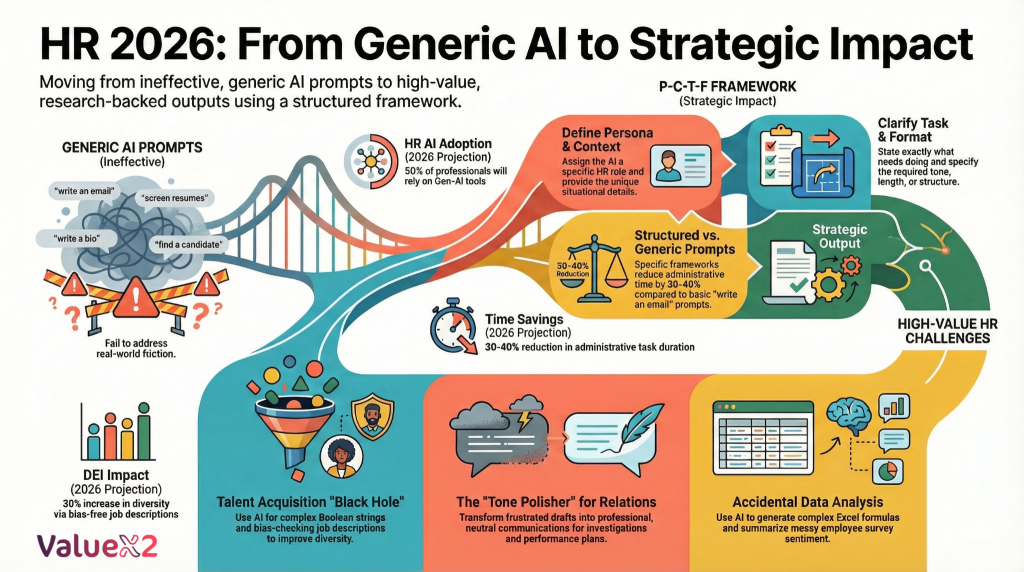
Executive Summary
By 2026, 50% of HR professionals will rely on generative AI tools to streamline their workflows. Yet most are using AI prompts that fail to address their actual daily friction points. Based on extensive research, this comprehensive prompt library addresses the specific, high-friction challenges HR professionals face—from Boolean search strings for broken LinkedIn filters to tone-polishing angry emails and summarizing messy grievance investigations neutrally.
This is not a collection of generic “Write a job description” prompts. This library provides structured, research-backed AI prompts using the P-C-T-F Framework (Persona, Context, Task, Format) that solve real problems encountered by HR practitioners in 2026.
What is AI in HR?
AI in HR simply means using intelligent tools to automate repetitive HR tasks, find patterns in people data, and support better decisions about hiring, development, performance, and employee experience. The biggest mistake HR leaders make is treating AI like an enterprise software rollout—buying licenses and mandating usage. Successful implementation requires pilot programs that mirror Agile development principles. This is leveraging Agility in HR for AI Implementation.
How to Implement AI in HR?
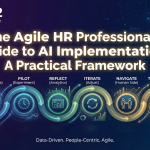
A practical framework – S.P.R.I.N.T. is what ValueX2 leverages because that’s exactly what this is: a series of focused iterations driven by data and analytics rather than a marathon deployment based on assumptions.
- S — SELECT: Choose your first AI battle wisely (and clean up first).
- P — PILOT: Run a true experiment with analytics at the center.
- R — REFLECT: Gather intelligence, analytics, and human insight.
- I — ITERATE: Make data‑driven adjustments in real time.
- N — NAVIGATE: Use analytics to manage the human side of change.
- T — TRANSFORM: Scale what the analytics prove is working.
What Makes This Prompt Library Different?
The Reality: Generic Prompts Fail HR Teams
Most AI prompt collections for HR offer surface-level solutions like:
- “Write a job description”
- “Create interview questions”
- “Draft an employee email”
The problem? These prompts ignore the nuanced, specific struggles HR professionals encounter daily.
The Research: What HR Professionals Actually Struggle With
Through deep analysis of HR community forums, software reviews, and practitioner feedback, we identified five core frustration areas:
- Talent Acquisition Volume Overload: 79% of job seekers now use AI in applications, flooding recruiters with similar-looking resumes while LinkedIn’s radius search repeatedly fails.
- High-Risk Employee Relations: Burned-out HR professionals need “tone checks” to transform angry drafts into professional communications without passive-aggressive language.
- Content Creation Demands: L&D teams struggle to convert topics into courses quickly, needing scripts, quizzes, and gamification ideas.
- Accidental Data Analysis: HR professionals without data science backgrounds must create Excel formulas and transform raw survey data into executive narratives.
- Inclusive Language Anxiety: Teams want to be inclusive but fear using outdated or offensive terminology.
The Solution: P-C-T-F Framework Prompts
Each prompt in this library uses the P-C-T-F Framework to deliver consistent, high-quality outputs:
- Persona: Define who the AI should act as (e.g., “empathetic Recruiter,” “Sourcing Expert”)
- Context: Provide specific situation details that shape the response
- Task: State exactly what needs to be accomplished
- Format: Specify tone, length, structure, or output requirements
Example Comparison:
Generic Prompt: “Write a rejection letter.”
ValueX2 P-C-T-F Prompt: “Act as an empathetic Recruiter (Persona). I am rejecting a candidate who was a culture fit but lacked technical Python skills (Context). Write a rejection email that encourages them to upskill and apply again in 6 months (Task). Use a warm, professional tone under 150 words (Format).”
Category 1: Talent Acquisition – The “Black Hole” of Time
Research Insight
Recruiters are overwhelmed by volume and ghosting. With 37% of US organizations using AI-driven platforms to automate talent acquisition and 79% of job seekers using AI tools in their applications, the challenge isn’t lack of candidates—it’s finding genuine, qualified matches amid the noise. Recruiters struggle specifically with technical sourcing (Boolean logic) and writing rejection emails that preserve employer brand.
Use Case 1: The “Radius Search” Workaround
The Problem: LinkedIn Recruiter’s radius search frequently fails to accurately filter candidates by location.
P-C-T-F Prompt:
Act as a Geographic Sourcing Specialist (Persona).
I need to find candidates willing to commute to our office in Manchester, England within 45 minutes during morning rush hour (Context).
Generate a comprehensive list of towns, cities, and boroughs within this commute radius that I can use to manually filter candidates in LinkedIn Recruiter (Task).
Present as a bulleted list organized by direction (North, South, East, West) with estimated commute times (Format).
Use Case 2: Boolean String Generator
The Problem: Creating complex Boolean search strings requires technical knowledge most recruiters don’t have, especially when combining multiple criteria.
P-C-T-F Prompt:
Act as a Technical Sourcing Expert specializing in Boolean search syntax (Persona).
I'm searching for a Senior DevOps Engineer with Kubernetes and AWS experience, excluding candidates from our competitors Amazon, Google, and Microsoft, and prioritizing those with Certified Kubernetes Administrator (CKA) certification (Context).
Create a complex Boolean search string optimized for LinkedIn Recruiter that includes these requirements, uses proper operators (AND, OR, NOT, parentheses), and excludes the specified companies (Task).
Provide the complete string on a single line, followed by a brief explanation of each component (Format).
Expected Output Structure:
- Complete Boolean string ready to copy-paste
- Component breakdown explaining the logic
- Suggested variations for broader/narrower results
Use Case 3: The “Passive Candidate” Hook
The Problem: Generic InMails to passive candidates get ignored. Personalization is time-consuming but essential for response rates.
P-C-T-F Prompt:
Act as an expert Recruiter specializing in passive candidate engagement (Persona).
I'm reaching out to a passive candidate who currently works as a Product Designer at Spotify and recently posted on LinkedIn about the challenge of designing for accessibility in music streaming apps (Context).
Draft a LinkedIn InMail that references their specific post to demonstrate genuine interest, introduces our Senior Product Designer opening at our fintech startup focused on accessible financial tools, and creates curiosity without being pushy (Task).
Keep under 150 words, use a conversational tone, end with a low-pressure question rather than a meeting request (Format).
Use Case 4: Bias-Checking Job Descriptions
The Problem: Gender-coded and exclusionary language in job descriptions reduces applicant diversity by up to 30%.
P-C-T-F Prompt:
Act as a Diversity, Equity, and Inclusion (DEI) Consultant specializing in recruitment language (Persona).
Review the following job description [PASTE JOB DESCRIPTION] for our Sales Manager role (Context).
Identify all instances of gender-coded language (words like 'ninja,' 'rockstar,' 'dominate,' 'aggressive'), age bias terms, unnecessary requirements that may exclude qualified candidates, and phrases that could discourage underrepresented groups from applying (Task).
For each issue found, provide: 1) the problematic phrase, 2) why it's problematic, 3) a neutral, inclusive alternative. Present in a table format (Format).
Use Case 5: Behavioral Interview Questions (Remote Context)
The Problem: Standard behavioral questions don’t address remote-specific competencies like self-direction, async communication, and digital collaboration.
P-C-T-F Prompt:
Act as an Industrial-Organizational Psychologist with expertise in remote workforce assessment (Persona).
I'm hiring a Marketing Manager who will lead a fully remote team of 8 across 5 time zones, focusing on digital campaign execution and cross-functional collaboration with product and sales teams (Context).
Generate 5 behavioral interview questions that specifically test for remote work competencies including asynchronous communication effectiveness, self-motivation without office structure, virtual team leadership, and managing across time zones (Task).
For each question, provide: 1) the question, 2) what competency it assesses, 3) what a strong answer includes. Use STAR method framework (Situation, Task, Action, Result) (Format).
Use Case 6: Rejection Letter (Empathetic, With Feedback)
The Problem: Generic rejection emails damage employer brand, while overly specific feedback creates legal risk. Finding the balance is difficult.
P-C-T-F Prompt:
Act as an empathetic Recruiter with expertise in candidate experience and employer branding (Persona).
I'm rejecting a candidate who reached the final interview round for our Senior Data Analyst position but wasn't selected because while their statistical knowledge was strong, they struggled to articulate how they'd translate complex analyses into actionable business recommendations for non-technical stakeholders (Context).
Draft a rejection email that delivers the decision respectfully, provides constructive feedback about communication skills without being legally risky, acknowledges their strengths in statistical analysis, and encourages them to apply again once they've developed their business communication skills (Task).
Use warm, professional tone; keep under 200 words; include a specific timeline suggestion (e.g., "in 6-12 months") for reapplication (Format).
Use Case 7: Job Post SEO Optimizer
The Problem: Job posts with non-standard titles or internal jargon don’t appear in search results on Indeed, Google Jobs, or LinkedIn.
P-C-T-F Prompt:
Act as a Recruitment Marketing Specialist with expertise in job post SEO (Persona).
Our company uses the internal title "Member Experience Champion" for what the industry calls "Customer Success Manager." The role involves onboarding new SaaS clients, managing renewals, and upselling features (Context).
Rewrite the job title and opening summary paragraph to rank higher for searches like "Customer Success Manager," "Client Success," "SaaS account management" on Indeed and Google Jobs, while maintaining our company's friendly culture (Task).
Provide: 1) optimized job title, 2) rewritten summary (100-150 words), 3) explanation of keyword strategy, 4) alternative title options to test (Format).
Use Case 8: Sourcing Intake Scribe
The Problem: Hiring managers often can’t articulate what they actually need, leading to misaligned searches and wasted time.
P-C-T-F Prompt:
Act as a Sourcing Expert and Talent Advisor with 15+ years of experience conducting hiring manager intake meetings (Persona).
I'm about to conduct an intake call with a hiring manager who submitted a vague job requisition for a "Senior Engineer" with minimal details about required skills, team dynamics, or success criteria (Context).
Create a list of the top 12 strategic questions I should ask during this intake call to clarify their true 'must-haves' vs. 'nice-to-haves,' understand team culture fit requirements, identify potential red flags, and set realistic expectations about candidate availability in the current market (Task).
Organize questions into four categories: Technical Requirements, Team & Culture, Timeline & Process, Success Metrics. For each question, briefly note why it matters (Format).
Use Case 9: Candidate Profile Summary
The Problem: Hiring managers receive 20+ resumes and don’t have time to read each one in detail.
P-C-T-F Prompt:
Act as an Executive Recruiter creating candidate briefing materials for C-suite hiring managers (Persona).
I'm presenting a candidate for our VP of Engineering role. Their resume shows 12 years of experience progressing from Senior Engineer at Shopify to Engineering Manager at Stripe to Director of Engineering at a Series B fintech startup, with consistent track record of scaling teams through hypergrowth and modernizing legacy systems (Context).
Summarize this candidate's profile into a compelling 3-bullet point "Why Hire" pitch that a busy CEO can absorb in 15 seconds, highlighting their most relevant achievements and unique value proposition (Task).
Each bullet should be one sentence, start with a strong action verb or quantified achievement, and directly address our company's current challenge of scaling our engineering team from 15 to 50 people while migrating from monolith to microservices (Format).
Use Case 10: Salary Negotiation Script
The Problem: Recruiters lose candidates during negotiation either by being too rigid or by immediately conceding before highlighting total compensation value.
P-C-T-F Prompt:
Act as a Compensation Consultant and skilled salary negotiator (Persona).
I'm the recruiter offering £75,000 base salary for a Marketing Manager role in Liverpool. The candidate is asking for £85,000 base. Our budget is firm at £75,000 base, but we have strong benefits: 10% annual bonus potential, £5,000 learning budget, 28 days holiday plus bank holidays, full remote flexibility, and company equity (Context).
Create a negotiation script that allows me to hold firm on the £75,000 base salary while strategically highlighting our comprehensive benefits package in a way that reframes the conversation from base salary to total compensation and career investment (Task).
Structure as: 1) empathetic acknowledgment of their request, 2) explanation of base salary position, 3) total compensation breakdown with monetary values, 4) closing question that gauges their flexibility. Keep conversational and collaborative in tone (Format).
Category 2: Employee Relations & Internal Communications – The “High Risk” Zone
Research Insight
HR professionals often use AI as a “tone check” because they’re burned out. A recurring sentiment on forums is using AI to “make me sound professional and less like a homicidal [person]” when dealing with difficult managers or sensitive situations. With 48% of HR teams reporting improved employee engagement after integrating AI into internal communication systems, the demand for emotionally intelligent, legally sound communication tools is clear.
Use Case 11: The “Tone Polisher”
The Problem: After the fifth time a manager misses a critical deadline, HR’s draft email is full of passive-aggressive language and frustration that would damage relationships.
P-C-T-F Prompt:
Act as a Professional Communication Coach specializing in difficult workplace conversations (Persona).
I've drafted an email to a department manager who has missed the employee performance review deadline for the third consecutive quarter, despite multiple reminders. My draft contains phrases like "Once again, you've failed to..." and "I'm not sure why this is so difficult..." which I know are unprofessional (Context).
Rewrite this email to be professional, firm, and collaborative while removing all passive-aggressive language, maintaining accountability for the missed deadline, and proposing a concrete solution with a specific deadline (Task).
Tone should be assertive but respectful, acknowledging they're likely overwhelmed while still requiring compliance. Keep under 150 words. Structure: 1) Direct statement of issue, 2) Impact explanation, 3) Required action with deadline, 4) Offer of support (Format).

Original Draft to Include:
[User pastes their angry draft here]
Use Case 12: Investigation Summarizer
The Problem: Grievance investigations produce messy, emotional witness statements. HR needs to present facts neutrally to decision-makers without inserting bias.
P-C-T-F Prompt:
Act as an impartial HR Investigator with training in employment law and neutral fact-finding (Persona).
I've conducted a workplace harassment investigation involving three witness statements about an alleged incident where a manager made inappropriate comments during a team meeting. Each witness provides different details, some corroborate each other, others conflict (Context).
Summarize these three witness statements [PASTE STATEMENTS] into a neutral, factual investigation report that highlights corroborating facts, identifies discrepancies without drawing conclusions about credibility, and organizes information chronologically (Task).
Use objective language ("Witness A stated..." not "Witness A claimed..."), avoid adjectives that imply judgment, present conflicting accounts side-by-side, and clearly separate facts from interpretations. Structure: 1) Allegation summary, 2) Witness statement summaries, 3) Corroborating facts, 4) Discrepancies identified (Format).
Use Case 13: Policy Interpreter (The “Handbook Bot”)
The Problem: Employees ask HR the same policy questions repeatedly, pulling HR away from strategic work. Answers must be accurate and consistent with written policy.
P-C-T-F Prompt:
Act as an HR Policy Specialist with expertise in employee handbook interpretation (Persona).
An employee has emailed asking if they can carry over 5 unused holiday days from this year to next year. Our Employee Handbook [PASTE RELEVANT POLICY SECTION] states that employees can carry over "up to 5 days with manager approval, to be used by March 31st" (Context).
Draft a polite, clear response email that directly answers their question by citing the specific handbook policy, explains the approval process (needs manager sign-off), clarifies the March 31st deadline, and provides the next step they should take (Task).
Use friendly, accessible language; avoid HR jargon; keep under 100 words; include the relevant handbook section reference for transparency (Format).
Use Case 14: PIP (Performance Improvement Plan) Drafter
The Problem: PIPs that are too vague create legal risk; those that are too harsh damage morale. Striking the balance requires precision.
P-C-T-F Prompt:
Act as an HR Business Partner with expertise in performance management and employment law (Persona).
I'm creating a Performance Improvement Plan for a Customer Support Representative who is struggling with response time targets (currently averaging 45 hours for first response vs. team target of 24 hours) and customer satisfaction scores (3.2/5 vs. team average of 4.1/5). Previous coaching conversations addressed these issues on [dates], but no improvement has occurred (Context).
Draft a 30-day PIP that outlines clear, measurable goals using SMART criteria (Specific, Measurable, Achievable, Relevant, Time-bound), specifies support provided (training, mentorship), defines check-in schedule, and clearly states consequences if goals aren't met (Task).
Tone should be supportive yet serious, emphasizing development opportunity while maintaining accountability. Structure: 1) Performance concerns with specific examples, 2) SMART goals for 30-day period, 3) Support provided, 4) Check-in schedule, 5) Consequences section. Include template for weekly check-in documentation (Format).
Use Case 15: Layoff/Termination Script
The Problem: Termination meetings require legal precision while preserving human dignity. Scripts help nervous managers stay on track.
P-C-T-F Prompt:
Act as an experienced HR Director who has conducted hundreds of termination meetings with compassion and legal compliance (Persona).
I need to create a script for terminating an employee due to position elimination during a company restructure. The employee has been with the company 4 years, is well-liked, and this is entirely due to business needs, not performance. They will receive 8 weeks severance, outplacement support, and continued benefits during severance period (Context).
Write a clear, compassionate script for the termination meeting that: delivers the decision in the first 30 seconds, explains this is a business decision unrelated to performance, outlines the severance package with specific details, provides immediate next steps, and includes a smooth transition statement to HR for offboarding logistics (Task).
Tone: compassionate but clear, avoiding ambiguous language that might create false hope. Length: 200-250 words. Include: 1) Opening decision statement, 2) Brief rationale, 3) Severance details, 4) Next steps, 5) Transition to HR. Also provide guidance on what NOT to say (Format).
Use Case 16: Return-to-Office FAQ
The Problem: Return-to-office mandates generate strong employee objections. Managers need consistent, empathetic answers to common pushback.
P-C-T-F Prompt:
Act as an HR Communications Specialist skilled in change management during workplace transitions (Persona).
Our company is implementing a new policy requiring employees to work in-office 3 days per week starting in 6 weeks, after 3 years of full remote work. We expect significant resistance around commute costs, childcare challenges, productivity concerns, work-life balance, and feelings of broken promises (Context).
Create a FAQ document anticipating the top 10 objections employees will raise about this policy change. For each objection, provide an empathetic but firm answer that acknowledges the concern, explains the business rationale (collaboration, culture, innovation), and offers practical solutions where possible (Task).
Tone: empathetic yet firm—validate feelings without reversing the decision. Each answer should be 50-75 words. Include these objections: commute costs, childcare, productivity evidence, housing moves made during remote period, health concerns, and 4 additional common objections you identify. Format as Q&A (Format).
Use Case 17: Conflict Resolution Roleplay
The Problem: Mediating peer conflicts requires preparation. HR needs to anticipate dynamics and prepare opening questions that de-escalate tension.
P-C-T-F Prompt:
Act as a certified workplace mediator with expertise in interpersonal conflict resolution (Persona).
I need to mediate a conflict between two peer employees on the same team. Employee A feels micromanaged and says Employee B constantly questions their work and doesn't trust them. Employee B feels ignored and says Employee A doesn't respond to questions or collaborate on shared projects. Both are good performers individually, and their manager wants them to resolve this (Context).
Simulate the opening of this mediation conversation by providing: 1) a neutral opening statement I should use to set expectations and ground rules, 2) five opening questions designed to help each person share their perspective without blame, 3) anticipated defensiveness or escalation points I should watch for, 4) reframing techniques if the conversation becomes accusatory (Task).
Present as: Opening statement script (75-100 words), followed by 5 questions with brief guidance notes on when to use each and what you're trying to uncover. Tone guidance: neutral facilitator, not problem-solver (Format).
Use Case 18: Announcement of Key Departure
The Problem: When a beloved leader leaves, poorly handled announcements create anxiety, rumors, and morale damage.
P-C-T-F Prompt:
Act as a Corporate Communications Professional specializing in internal change communications (Persona).
Our VP of Engineering, who's been with the company 7 years and is beloved by the team, is leaving for a new opportunity. We want to announce this before rumors spread, while maintaining team morale and confidence in the transition plan. Her last day is 4 weeks away, and we're promoting the current Director of Engineering to her role (Context).
Draft an email announcement to the engineering team that: celebrates her contributions with specific examples, explains she's leaving for career growth (not due to company problems), introduces the internal promotion and their qualifications, outlines the transition timeline, and ends on a forward-looking, positive note (Task).
Tone: warm, appreciative, confident about the future. Length: 200-250 words. Structure: 1) Announcement with positive framing, 2) Legacy/contributions, 3) Transition plan, 4) New leader introduction, 5) Forward-looking close. Avoid corporate clichés like "pursuing other opportunities" (Format).
Use Case 19: “Difficult Conversation” Starter – Hygiene Issues
The Problem: Addressing personal hygiene with an employee is mortifying for everyone involved, but ignoring it affects the whole team.
P-C-T-F Prompt:
Act as an HR Professional with expertise in handling sensitive personal conversations with dignity (Persona).
I need to address a hygiene concern (body odor) with an employee after receiving multiple complaints from team members. This is deeply uncomfortable and I want to handle it with maximum dignity and minimal embarrassment while ensuring the issue is resolved (Context).
Provide a script for opening this conversation that: 1) is direct about the issue without being graphic, 2) avoids shaming language, 3) acknowledges this is uncomfortable, 4) focuses on workplace impact rather than personal judgment, 5) offers support if there's an underlying medical or personal issue, 6) clearly states the expectation for improvement (Task).
Include: Opening statement (3-4 sentences), anticipated responses (defensive, embarrassed, medical explanation) with how to respond to each, closing statement with follow-up plan. Tone: compassionate, matter-of-fact, private. Length: 150-200 words for full script (Format).
Use Case 20: Whistleblower Response
The Problem: Anonymous complaints require immediate acknowledgment that balances transparency with confidentiality and legal protection.
P-C-T-F Prompt:
Act as an HR Compliance Officer with expertise in whistleblower protection and workplace investigations (Persona).
We received an anonymous complaint through our ethics hotline alleging financial misconduct by a senior manager. We need to acknowledge receipt to the whistleblower while protecting confidentiality and outlining our investigation process (Context).
Draft a template response email that: acknowledges receipt of the complaint, assures confidentiality and protection from retaliation, outlines the investigation process and typical timeline, explains what follow-up communication they can expect, provides contact information for questions, and thanks them for coming forward (Task).
Tone: serious, professional, reassuring. Length: 150-200 words. Must include: 1) Acknowledgment, 2) Confidentiality assurance, 3) Process overview with timeline, 4) Next steps, 5) Contact information. Language should be legally appropriate but not overly legalistic (Format).
Category 3: Learning & Development – The “Content Factory”
Research Insight
L&D teams are drowning in content creation needs. With 33% of HR departments applying generative AI to create personalized learning paths and 39% increase in generative AI-generated training content adoption in 2025, the pressure to move from “Topic” to “Course” quickly has never been higher. The challenge isn’t ideation—it’s rapid execution while maintaining quality and engagement.
Use Case 21: Microlearning Script Generator
The Problem: Long-form training content doesn’t fit modern attention spans or mobile learning. Converting traditional content to microlearning is time-intensive.
P-C-T-F Prompt:
Act as an Instructional Designer specializing in microlearning and mobile-first learning experiences (Persona).
I have a 20-page PDF training document on Cybersecurity Best Practices covering: password management, phishing identification, secure file sharing, social engineering, and data classification. Our employees want bite-sized learning they can consume during commute or coffee breaks (Context).
Break down this content [PASTE PDF OR KEY SECTIONS] into 5 scripts for 60-second TikTok-style microlearning videos, with each video covering one key concept. Each script should include: hook (first 5 seconds to grab attention), core teaching point, practical example employees can relate to, and call-to-action (Task).
Format each script as: Title, Hook, Core Content (3-4 bullet points), Example, CTA. Include notes on suggested visuals or on-screen text. Keep each script 150-175 words maximum when read aloud. Tone: conversational, not corporate (Format).
Use Case 22: Quiz Generator (Multiple Choice)
The Problem: Creating quality assessment questions with plausible distractors requires expertise in learning science, and it’s time-consuming.
P-C-T-F Prompt:
Act as an Educational Assessment Specialist with expertise in creating valid, reliable knowledge checks (Persona).
I need to assess comprehension of our "Inclusive Leadership" training module that covers: recognizing unconscious bias, psychological safety, equitable resource allocation, amplifying underrepresented voices, and inclusive meeting facilitation (Context).
Create a 10-question multiple-choice quiz based on this content [PASTE TRAINING CONTENT]. Each question should include one correct answer and three plausible distractors (wrong answers that learners might believe if they didn't fully understand the material). Questions should test comprehension and application, not just memorization (Task).
For each question, provide: 1) the question, 2) four answer options (labeled A-D), 3) correct answer marked, 4) brief explanation of why it's correct and why distractors are incorrect. Mix difficulty levels: 4 easy, 4 medium, 2 challenging. Format as numbered list (Format).
Use Case 23: Learning Needs Analysis
The Problem: Training programs fail when built on assumptions rather than actual skill gaps. Needs analysis surveys must ask the right questions.
P-C-T-F Prompt:
Act as an L&D Consultant with expertise in conducting Training Needs Analyses (TNA) (Persona).
I'm conducting a Training Needs Analysis for our sales team (35 people, mix of new hires and 5+ year veterans) to identify skill gaps in consultative selling, CRM utilization, objection handling, and negotiation (Context).
Design 8 survey questions that will effectively identify specific skill gaps in these areas, differentiate between individual vs. team-wide needs, and help prioritize training investments. Include mix of question types: Likert scale confidence ratings, multiple choice skill assessment, and open-ended gap identification (Task).
Format: Present each question with: 1) the question text, 2) response options, 3) what insight this question provides, 4) how to interpret responses. Include an introductory paragraph for the survey explaining purpose and anonymity (Format).
Use Case 24: Course Outline Builder
The Problem: Converting a training topic into a structured learning journey with clear objectives requires instructional design expertise most L&D teams lack.
P-C-T-F Prompt:
Act as a Senior Instructional Designer with 15+ years creating leadership development programs (Persona).
I need to create a 4-week virtual workshop on "Emotional Intelligence for New Managers" for 15 first-time managers who were recently promoted from individual contributor roles. Sessions are 90 minutes each, once weekly, with homework assignments between sessions (Context).
Create a detailed course outline that includes: weekly session titles, 3-5 learning objectives per session (using Bloom's Taxonomy action verbs), key topics covered, activities/exercises, homework assignments, and how each week builds on the previous (Task).
Format as: Week 1-4 headers, with subsections for: Learning Objectives, Topics Covered (with time allocations), In-Session Activities, Homework, Materials Needed. Include an introductory section explaining the overall course arc and how EQ skills will be practiced progressively (Format).
Use Case 25: Roleplay Scenario Generator
The Problem: Effective roleplay scenarios need to be realistic, specific enough to be useful, but flexible enough for multiple learners to practice.
P-C-T-F Prompt:
Act as a Sales Training Specialist who creates realistic practice scenarios for skill development (Persona).
I'm designing a sales training session where participants will practice objection handling. I need a realistic roleplay scenario involving a B2B customer who is angry about receiving a defective product shipment and is demanding a full refund and threatening to switch to a competitor (Context).
Create a detailed roleplay scenario that includes: 1) background context for both the "customer" and "salesperson" roles, 2) specific details about the situation (product, timeline, previous interactions), 3) customer's objectives and emotional state, 4) challenging objections the customer should raise, 5) successful resolution criteria (Task).
Format as: Scenario Title, Background (100 words), Role A (Customer) Brief (what they know, their goal, their emotional state, 3-4 objections to raise), Role B (Salesperson) Brief (what they know, their goal, available solutions), Success Criteria (what does good resolution look like), Debrief Questions (3-4 questions for post-roleplay discussion) (Format).
Use Case 26: Gamification Ideas
The Problem: Mandatory compliance training has dismal completion rates. Gamification can help, but L&D teams don’t know where to start.
P-C-T-F Prompt:
Act as a Learning Experience Designer specializing in gamification and engagement strategies for corporate training (Persona).
Our mandatory annual compliance training (data protection, anti-harassment, financial ethics) has a 65% completion rate despite multiple reminder emails. The training is a 45-minute eLearning module that employees find boring and irrelevant. We have a limited budget and can't purchase expensive gamification platforms (Context).
Suggest 3 low-cost gamification strategies that could increase completion rates for this mandatory compliance training, using tools we likely already have (LMS features, Microsoft Forms, Teams, basic video tools). Each strategy should create motivation through competition, progress visualization, or social accountability (Task).
For each strategy provide: 1) Strategy name and description, 2) Implementation steps (how to set it up), 3) Why it increases motivation (psychological principle), 4) Estimated time/cost to implement, 5) Potential challenges. Prioritize ideas that work for remote/hybrid teams (Format).
Use Case 27: “Lunch and Learn” Agenda
The Problem: Lunch and learns often lack structure, run over time, or fail to engage participants who are eating and partially distracted.
P-C-T-F Prompt:
Act as an Internal Communications Manager skilled at facilitating engaging lunch-and-learn sessions (Persona).
I'm hosting a 45-minute virtual Lunch and Learn on "Personal Financial Wellness: Understanding Your Pension and Retirement Planning" for our employee population (mix of ages 25-60). Participants will be eating lunch, so I need to keep it engaging and interactive, not lecture-heavy (Context).
Design a complete session agenda that includes: a 5-minute icebreaker relevant to the topic, content delivery broken into digestible segments, 2-3 interactive elements (polls, Q&A, discussion), time buffer for questions, and a clear takeaway/action item employees can implement this week (Task).
Format as: Time-blocked agenda (e.g., 0-5 min: Icebreaker) with activity descriptions, materials needed, and facilitation notes. Include: suggested poll questions, discussion prompts, and a "parking lot" strategy for questions you can't answer live. Total: 45 minutes including buffer time (Format).
Use Case 28: Skill Gap Analyzer
The Problem: When hiring for internal mobility or external candidates, HR needs to quickly identify what training will be required to close skill gaps.
P-C-T-F Prompt:
Act as a Talent Development Analyst specializing in skills mapping and gap analysis (Persona).
I'm comparing the required skills in our Senior Data Analyst job description [PASTE JD] against the current skills on an internal candidate's resume/profile [PASTE RESUME/SKILLS], who is applying for internal promotion (Context).
Analyze both documents and identify the top 3-5 skill gaps where the candidate would need training or development to be successful in the Senior Data Analyst role. For each gap, assess whether it's critical (must have immediately), important (should develop within 3-6 months), or preferred (nice to have but not essential) (Task).
Format as table with columns: Skill Gap | Criticality Level (Critical/Important/Preferred) | Current Proficiency Evidence (what they DO have) | Recommended Development Action (training, mentorship, stretch project). Include a summary paragraph with overall promotion readiness assessment (Format).
Use Case 29: Presentation Slide Text
The Problem: Converting dense articles or reports into presentation-ready slide content requires summarization skills and understanding of visual hierarchy.
P-C-T-F Prompt:
Act as a Presentation Designer who transforms complex content into clear, visual slides (Persona).
I need to create a presentation for senior leadership on this article about the impact of AI on workforce planning [PASTE ARTICLE OR SUMMARY]. The presentation will be 5 slides including a title slide (Context).
Summarize this article into text for 5 PowerPoint slides following this structure: Slide 1: Title and one-sentence overview, Slide 2: The Problem/Challenge, Slide 3: Key Research Findings (3-4 bullet points), Slide 4: Implications for Our Organization, Slide 5: Recommended Next Steps (Task).
For each slide, provide: Slide Number, Title (concise, action-oriented), Body Text (3-5 bullet points maximum, each 8-12 words), and Visual Suggestion (what chart, image, or icon would support this content). Keep language executive-appropriate: clear, concise, data-driven (Format).
Use Case 30: Mentorship Program Structure
The Problem: Informal mentorship programs fizzle out. Structure and accountability are needed, but too much structure makes them feel bureaucratic.
P-C-T-F Prompt:
Act as a Leadership Development Consultant specializing in mentorship program design (Persona).
We want to launch a formal 6-month mentorship program pairing 20 high-potential employees (mentees) with senior leaders (mentors) to support career development, leadership skill building, and organizational knowledge transfer (Context).
Design a complete 6-month mentorship program structure that includes: monthly discussion themes to guide conversations, suggested activities beyond just meetings, progress tracking templates that don't feel burdensome, kickoff and closing events, and guidelines for both mentors and mentees on expectations and time commitment (Task).
Format as: Program Overview (objectives, time commitment), Monthly Meeting Themes (Month 1-6 with 2-3 discussion prompts each), Suggested Activities (job shadowing, project collaboration, etc.), Progress Tracking Template (simple monthly check-in form), Success Metrics (how we'll measure program effectiveness). Include a one-page "Mentor Guide" and one-page "Mentee Guide" summarizing expectations (Format).
Category 4: HR Operations & Analytics – The “Excel Hell” Escape
Research Insight
HR professionals are often accidental data analysts. With 46% of HR leaders now using AI to provide real-time performance feedback to employees and analytics platforms improving employee risk scoring accuracy by 44%, the pressure to translate data into narratives has intensified. They struggle with Excel formulas, transforming raw survey data into insights, and communicating findings to executives who want “the story,” not the spreadsheet.
Use Case 31: Excel Formula Bot
The Problem: HR pros aren’t Excel experts but need complex formulas for workforce planning, tenure calculations, and compensation analysis.
P-C-T-F Prompt:
Act as an Excel Expert specializing in HR workforce analytics (Persona).
I have a spreadsheet with employee 'Start Date' in Column A (format: DD/MM/YYYY) and today's date will auto-populate in Column B using =TODAY(). I need to calculate each employee's tenure in a readable format showing years and months (e.g., "3 years, 5 months") in Column C (Context).
Write the exact Excel formula I should enter in cell C2 that calculates tenure in years and months from the start date, and can be dragged down to apply to all rows. Also explain each component of the formula so I understand what it's doing (Task).
Provide: 1) The complete formula ready to copy-paste into C2, 2) Step-by-step breakdown explaining each part of the formula, 3) Instructions for applying to remaining rows, 4) How to handle potential errors (blank start dates). Use UK date format conventions (Format).
Use Case 32: Survey Sentiment Analysis
The Problem: Annual engagement surveys generate hundreds of open-text responses. Manual categorization takes days and is inconsistent.
P-C-T-F Prompt:
Act as a People Analytics Specialist with expertise in qualitative data analysis and sentiment categorization (Persona).
We conducted our annual employee engagement survey and received 500 open-text responses to the question "What would most improve your experience working here?" I need to analyze these responses to identify patterns and present themes to leadership (Context).
[PASTE SURVEY RESPONSES or provide in batches]
Analyze these open-text responses and: 1) Categorize them into 3-5 main themes based on recurring topics, 2) Assign a sentiment score (Positive/Neutral/Negative) to each theme based on the tone of comments within that category, 3) Identify representative quotes for each theme, 4) Quantify how many responses fall into each theme (Task).
Present as: Executive Summary (2-3 sentences), Theme Breakdown Table (Theme Name | # of Responses | Sentiment | Description | Representative Quote), Key Insights (3-4 bullets highlighting what matters most). If responses reference specific departments or managers, anonymize them (Format).
Use Case 33: Turnover Narrative
The Problem: Executives don’t want just turnover percentages—they want the “why” and “what we should do about it.”
P-C-T-F Prompt:
Act as a People Analytics Consultant presenting workforce insights to C-suite executives (Persona).
Our company turnover rate increased from 12% in Q2 to 22% in Q3 (2026). Exit interview data suggests the primary drivers are: lack of career development opportunities (mentioned by 45% of exiters), below-market compensation (mentioned by 38%), and return-to-office mandate implemented in July (mentioned by 31%). We operate in the technology sector where market turnover average is 16% (Context).
Write a brief executive summary (250-300 words) that: explains the Q3 turnover increase, presents the three main causes with data support, contextualizes our 22% against the 16% industry average, hypothesizes why the return-to-office mandate may be disproportionately affecting our tech talent, and proposes three specific interventions to reduce turnover in Q4 (Task).
Structure: Opening (state the problem with data), Analysis (three causes with supporting percentages), Context (industry comparison), Hypothesis (why RTO matters for this population), Recommendations (3 specific, actionable interventions). Tone: data-driven, solution-focused, urgent but not alarmist (Format).
Use Case 34: Boolean for ATS
The Problem: Finding candidates in your ATS who meet specific criteria requires Boolean search knowledge. Most HRIS users don’t have it.
P-C-T-F Prompt:
Act as an ATS (Applicant Tracking System) search optimization specialist (Persona).
I need to search our ATS database to find past candidates who have Project Management experience for an internal mobility opportunity. However, I want to exclude anyone whose most recent experience was in Construction, as the role is focused on technology project management. Our ATS supports Boolean search operators (Context).
Create a Boolean search string I can use in our ATS to find candidates with "Project Management" OR "Programme Management" OR "Project Coordinator" experience, but explicitly EXCLUDE anyone with "Construction" in their profile (Task).
Provide: 1) Complete Boolean string ready to copy-paste, 2) Explanation of the logic, 3) Alternative search strings if the first doesn't return enough results (broadening the search), 4) Tip for checking if results match the criteria. Account for UK vs US spelling variations (Programme/Program) (Format).
Use Case 35: Meeting Note Summarizer
The Problem: HR team meetings generate pages of notes, but extracting action items and decisions is time-consuming.
P-C-T-F Prompt:
Act as an Executive Assistant skilled at synthesizing meeting notes into actionable summaries (Persona).
I've just finished a 90-minute HR Leadership team meeting and have detailed notes/transcript [PASTE NOTES/TRANSCRIPT]. The meeting covered Q4 hiring plans, benefits open enrollment communications, and performance review timeline adjustments (Context).
Summarize this meeting transcript into three distinct sections: 1) Key Decisions Made (what was decided and any important context), 2) Action Items with owners and deadlines, 3) Open Questions or topics tabled for future discussion (Task).
Format as: Meeting Date header, three clearly labeled sections as described, bullet points within each section, bolded names for action item owners, **deadlines in bold**, questions formatted with "?" symbol. Keep total summary under 300 words. If any decisions contradict previous plans, flag with [NOTE: Change from previous direction] (Format).
Use Case 36: Policy Comparison
The Problem: HR doesn’t know if policies are competitive without manual research and comparison—time they don’t have.
P-C-T-F Prompt:
Act as an HR Benchmarking Consultant specializing in compensation and benefits analysis (Persona).
Our current parental leave policy [PASTE POLICY] offers: 2 weeks paid paternity leave, 12 weeks paid maternity leave, and no adoption leave policy. We're a technology company with 200 employees in the UK, competing for talent with companies like Deliveroo, Monzo, and Revolut (Context).
Compare our parental leave policy against standard UK tech industry benchmarks and identify where we are lagging behind competitors in ways that could hurt talent attraction and retention, particularly for working parents and employees considering adoption (Task).
Format as: Executive Summary (2-3 sentences), Policy Comparison Table (Our Policy | Industry Standard/Competitor Benchmark | Gap), Competitive Risk Assessment (which gaps hurt us most in recruitment), Recommendations (3 specific policy improvements prioritized by impact and cost). Include data sources where possible (Format).
Use Case 37: Headcount Budget Request
The Problem: Finance rejects headcount requests that lack clear ROI. HR needs to make business cases, not just ask for “more people.”
P-C-T-F Prompt:
Act as an HR Finance Business Partner skilled at building ROI-based headcount justifications (Persona).
I need to request budget approval for 2 new Customer Support Representatives. Our current support team of 5 people is overwhelmed: average ticket resolution time has increased from 8 hours to 24 hours over the past 6 months, customer satisfaction scores dropped from 4.5/5 to 3.8/5, and we're receiving 40% more support tickets due to customer growth. Each support rep costs approximately £35,000 annually including benefits (Context).
Draft a business case to the CFO requesting budget for 2 new Customer Support headcount, focusing on ROI (reduced ticket times, improved customer retention, revenue protection), quantifying the cost of NOT hiring (customer churn risk), and connecting support quality to business outcomes (Task).
Structure: Problem Statement with metrics (current state), Business Impact (how current situation hurts revenue/retention), Proposed Solution (2 new hires), ROI Calculation (how this pays for itself through retention or efficiency), Timeline (how quickly we'll see improvement), Risk of Inaction. Length: 300-400 words. Tone: data-driven, financially savvy, addressing CFO priorities (Format).
Use Case 38: Shift Scheduling Communication
The Problem: Changes to shift patterns trigger anxiety and resistance from staff. Communication must emphasize benefits, not just state changes.
P-C-T-F Prompt:
Act as an HR Operations Manager skilled in change management communications for frontline workers (Persona).
We're changing our Customer Support shift patterns from five 8-hour shifts per week to four 10-hour shifts per week, giving employees three consecutive days off instead of two. This change is driven by operational needs (better weekend coverage) but also genuinely benefits employees through more consecutive rest days. Some staff are nervous about longer shifts (Context).
Draft an email to Customer Support staff explaining this shift pattern change, emphasizing the benefit of three consecutive days off (better work-life balance, ability to take weekend trips, reduced commute days), acknowledging the adjustment to longer shift days, and providing details on implementation timeline and how individual schedules will be determined (Task).
Tone: positive, empathetic to concerns, benefit-focused. Structure: Opening (announcement of change with positive framing), Benefits (why this is good for employees - 3-4 specific benefits), Acknowledgment (we know longer days are an adjustment), Details (timeline, how schedules will be assigned, flexibility options), Q&A Process (how to ask questions). Length: 250-300 words (Format).
Use Case 39: Vendor RFP Questions
The Problem: Evaluating HRIS, payroll, or benefits vendors requires knowing what questions to ask. Missing critical questions leads to bad vendor selection.
P-C-T-F Prompt:
Act as an HR Technology Consultant who evaluates HRIS platforms for mid-sized companies (Persona).
We're issuing an RFP (Request for Proposal) for a new HRIS vendor to replace our current system. We're a 300-person company with remote employees across the UK and expanding into Europe. We need core HR, payroll integration, performance management, and recruiting modules. Our top concerns are data security (we handle sensitive financial data) and integration capabilities with our existing tools (Slack, BambooHR, Xero accounting) (Context).
Generate 10 critical vetting questions for the RFP that focus on data security standards, integration capabilities with our existing tech stack, European data compliance (GDPR), implementation timeline and support, and scalability as we grow (Task).
Format: Numbered list of 10 questions, organized by category (3 questions on Security & Compliance, 3 on Integration Capabilities, 2 on Implementation & Support, 2 on Scalability). For each question, include a brief note on why this question matters and what "good" answers should include. Avoid generic questions like "Do you offer customer support?" - make them specific and revealing (Format).
Use Case 40: Org Chart Restructure Analysis
The Problem: Leadership considers restructuring but doesn’t understand the trade-offs between organizational models.
P-C-T-F Prompt:
Act as an Organizational Development Consultant specializing in org design and restructuring (Persona).
Our company (500 employees) is considering moving from a functional organizational structure (departments organized by function: Marketing, Sales, Product, Engineering) to a matrix structure (employees report to both functional manager and project/product manager). Leadership believes this will improve cross-functional collaboration but is concerned about complexity and reporting confusion (Context).
Create a pros and cons analysis comparing our current functional structure to the proposed matrix structure. For each pro and con, explain WHY it's a benefit or challenge, and for whom (executives, middle managers, individual contributors). Include consideration of: decision-making speed, career development clarity, resource allocation flexibility, and employee experience (Task).
Format as: Introduction (2-3 sentences explaining the restructure being considered), Two-column comparison table (Functional Structure | Matrix Structure) with 3 Pros and 3 Cons for each, Considerations section addressing the four factors mentioned, Recommendation section (neutral, presenting decision criteria for leadership). Total length: 400-500 words (Format).
Category 5: Culture & DEI – The “Belonging” Builder
Research Insight
HR wants to be inclusive but fears using the wrong terminology. With 44% of HR teams using AI-based sentiment analysis tools to measure employee morale in real-time and 18% of enterprises using generative AI to develop diversity training modules, there’s growing need for guidance on language, recognition, and creating psychological safety. The risk of getting it wrong—whether through outdated language or performative gestures—is high.
Use Case 41: Inclusive Language Checker
The Problem: Well-meaning communications accidentally include ableist, gendered, or exclusionary language that alienates employees.
P-C-T-F Prompt:
Act as a DEI (Diversity, Equity, and Inclusion) Language Consultant specializing in inclusive workplace communications (Persona).
I've drafted a company-wide email announcing our new flexible working policy [PASTE EMAIL DRAFT]. I want to ensure it doesn't contain ableist language (like "stand-up meeting"), unnecessarily gendered language (like "guys" or "chairman"), age-biased terms, or phrases that exclude certain groups (Context).
Review this email for inclusive language issues, identifying: 1) ableist language and alternatives, 2) gendered terms and neutral replacements, 3) idioms or cultural references that may not translate across our diverse workforce, 4) assumptions about family structures or caregiving (e.g., "working mothers"), 5) any other exclusionary language (Task).
Format as table: Original Phrase | Issue Type | Why It's Problematic | Inclusive Alternative | Explanation. After the table, provide the full email rewritten with all suggested changes incorporated. Include a 2-3 sentence note on overall tone and approach (Format).
Use Case 42: Culture Survey Questions
The Problem: Generic engagement surveys don’t measure what actually matters for belonging and psychological safety.
P-C-T-F Prompt:
Act as an Organizational Psychologist specializing in psychological safety and team dynamics research (Persona).
We want to measure 'Psychological Safety' within our teams—specifically, whether employees feel comfortable speaking up in meetings, admitting mistakes, asking questions, and challenging ideas without fear of embarrassment or retaliation. Our current engagement survey doesn't address this (Context).
Draft 5 specific survey questions (using 5-point Likert scale from Strongly Disagree to Strongly Agree) that accurately measure psychological safety in meetings and team interactions. Questions should be clear, specific (not vague like "I feel safe"), and actionable (responses should point to specific behaviors we can improve) (Task).
For each question provide: 1) Question text, 2) 5-point scale labels, 3) What dimension of psychological safety this measures (e.g., risk of embarrassment vs. fear of retaliation), 4) What a "low score" on this question indicates we should address. Ensure questions work for both in-person and remote teams (Format).
Use Case 43: Recognition Message Generator
The Problem: Public recognition that feels generic doesn’t motivate. Specific, values-aligned recognition does, but writing it takes time.
P-C-T-F Prompt:
Act as an HR Business Partner skilled at writing meaningful employee recognition that reinforces company values (Persona).
I want to publicly recognize a software engineer, Sarah, who stayed late last week (worked until 11 PM for 3 nights) to fix a critical bug that was blocking a major client's product launch. I want to celebrate her commitment and technical skill while reinforcing our company values of 'Customer Obsession' and 'Teamwork' (she collaborated with support and product teams to diagnose the issue) (Context).
Write a public recognition message (for posting in our company Slack or all-hands meeting) that: 1) specifically describes what Sarah did, 2) explains the impact her work had on the customer and business, 3) connects her actions to our values of Customer Obsession and Teamwork, 4) is authentic (not over-the-top or corporate-sounding) (Task).
Length: 75-100 words. Tone: genuine, specific, celebratory but not cheesy. Include Sarah's name and enough detail that everyone understands what she did, but avoid technical jargon. Structure: What happened → Impact → Values connection (Format).
Use Case 44: DEI Statement Drafter
The Problem: DEI statements on careers pages often sound performative. Authentic statements require specific commitments and proof points.
P-C-T-F Prompt:
Act as a DEI Communications Specialist who writes authentic, credible diversity statements for employer branding (Persona).
We're updating our careers page and need a DEI commitment statement. We want to specifically highlight our commitment to Neurodiversity (we have accommodations like flexible schedules, quiet working spaces, and sensory-friendly interview options) and Flexible Working (unlimited remote work, no core hours requirements). We're a 150-person fintech startup in London (Context).
Draft a DEI commitment statement for our careers page that: 1) articulates our commitment to neurodiversity and flexible working specifically (not just generic "we value diversity"), 2) includes concrete examples of what we actually DO (not just what we believe), 3) feels authentic rather than corporate checkbox-ticking, 4) invites candidates to discuss accommodations openly (Task).
Length: 125-175 words. Tone: authentic, specific, welcoming. Structure: Opening statement of commitment → Specific focus areas (neurodiversity, flexibility) with concrete examples → Invitation to candidates. Avoid buzzwords like "leveraging" or "paradigm" (Format).
Use Case 45: Holiday Calendar Communications
The Problem: Acknowledging religious and cultural holidays without tokenism or errors requires cultural knowledge and sensitivity.
P-C-T-F Prompt:
Act as a Multicultural Workplace Communications Specialist with expertise in religious and cultural holiday acknowledgments (Persona).
Ramadan begins next week, and we have Muslim employees on our team (approximately 15% of our 200-person company). I want to send a company-wide email acknowledging Ramadan, explaining its significance briefly for those unfamiliar, and expressing support for employees who will be fasting (Context).
Draft a respectful company-wide email that: 1) acknowledges that Ramadan begins [DATE], 2) briefly explains its significance (without over-explaining or being patronizing), 3) expresses company support for employees observing (e.g., flexibility for prayer times, early meeting scheduling to accommodate fasting), 4) avoids common mistakes like saying "Happy Ramadan" (inappropriate), 5) is inclusive of non-Muslim employees without making Muslim employees feel "othered" (Task).
Length: 100-150 words. Tone: respectful, warm, educational without being preachy. Structure: Acknowledgment → Brief explanation → Support offered → Inclusive close. Include a note on what phrases to avoid and why (Format).
Use Case 46: Employee Resource Group (ERG) Charter
The Problem: ERGs without structure and clear purpose fizzle out quickly. A charter creates accountability and direction.
P-C-T-F Prompt:
Act as a DEI Program Manager specializing in Employee Resource Group (ERG) development and sustainability (Persona).
We're launching a new Employee Resource Group called "Women in Tech" for our technology company (300 employees, currently 28% women in technical roles). We need a charter that defines the group's mission, leadership structure, meeting cadence, and how success will be measured (Context).
Create a complete ERG charter template for "Women in Tech" that includes: 1) Mission statement (what the group exists to accomplish), 2) Leadership structure (roles: Chair, Vice-Chair, Events Coordinator - with responsibilities for each), 3) Meeting cadence and format, 4) Membership criteria (open to whom?), 5) Annual goals/priorities, 6) Success metrics, 7) Company support/resources provided (Task).
Format as: Formal charter document with sections clearly labeled. Mission statement: 2-3 sentences. Leadership structure: table with Role | Responsibilities | Time Commitment. Include notes on how leaders will be selected and term lengths. Total length: 500-600 words. Tone: professional, empowering, clear (Format).
Use Case 47: Bias Training Scenarios
The Problem: Unconscious bias training needs realistic, recognizable scenarios that help employees identify bias in real situations.
P-C-T-F Prompt:
Act as a DEI Trainer who creates realistic scenarios for unconscious bias training workshops (Persona).
I'm developing a training module on "Unconscious Bias in Hiring" and need to create a realistic video script demonstrating how affinity bias (favoring candidates similar to yourself) shows up in a hiring meeting. The scenario should be subtle—not an obvious villain—showing how well-meaning people make biased decisions (Context).
Write a script for a 3-4 minute video scene showing a hiring team meeting discussing two final candidates: Candidate A (went to the same university as the hiring manager, mentions playing football like the hiring manager, similar background) and Candidate B (objectively stronger experience, but different background, no personal commonalities with hiring manager). Show how the hiring manager unconsciously favors Candidate A through language like "culture fit" and "I just have a good feeling" (Task).
Format as: Scene description, character list (3-4 people in meeting with brief character descriptions), dialogue script with character names, stage directions [in brackets], and a "Debrief Questions" section with 4-5 questions to ask viewers after watching. Script should feel realistic - natural conversation, not on-the-nose or preachy. Length: 600-700 words (Format).
Use Case 48: Onboarding Buddy Guide
The Problem: New hires assigned “onboarding buddies” often don’t know what they’re supposed to do, resulting in awkward, unhelpful relationships.
P-C-T-F Prompt:
Act as an Onboarding Experience Designer who creates buddy program materials (Persona).
We're implementing an "Onboarding Buddy" program where every new hire is paired with a peer (not their manager) to help them acclimate during their first 30 days. Buddies need clear guidance on their role: what they should help with, what they should NOT do (like formal training or performance feedback), and how to ensure new hires feel welcome (Context).
Create a checklist guide for Onboarding Buddies titled "Your Role as an Onboarding Buddy: First 30 Days" that includes: 1) What a buddy IS and ISN'T (role clarification), 2) Week 1 checklist (specific things to do), 3) Week 2-4 checklist, 4) Conversation starters/questions to ask new hire, 5) Red flags to escalate to manager or HR (Task).
Format as: Introduction paragraph (2-3 sentences), Role Clarification section (Buddy IS... / Buddy IS NOT... in two columns), Week-by-week checklist (bullet points), Conversation Starters (5-6 questions), Red Flags section (3-4 concerns to escalate). Length: 400-500 words. Tone: supportive, practical, clear (Format).
Use Case 49: “Stay Interview” Script
The Problem: Exit interviews happen too late. Stay interviews with high-performers can prevent turnover, but managers don’t know what to ask.
P-C-T-F Prompt:
Act as a Retention Strategist who coaches managers on conducting effective Stay Interviews (Persona).
One of my top-performing engineers has been with the company 18 months and is doing excellent work. I'm worried about losing her because several of her peers have left recently for higher-paying roles at tech startups. I want to conduct a "Stay Interview" to understand what keeps her here, what might drive her away, and how I can support her development—but I don't want it to feel like a performance review or put ideas in her head about leaving (Context).
Generate 5 open-ended questions for a Stay Interview that will help me understand: 1) what she values most about working here, 2) what frustrations or concerns she has, 3) her career aspirations, 4) what would make her consider leaving, 5) how I can better support her. Questions should feel conversational and genuinely curious, not interrogative (Task).
Format as: Brief introduction (2-3 sentences on how to set up the conversation), 5 numbered questions with guidance notes after each question explaining: what you're trying to learn, how to listen for concerns, and suggested follow-up questions. Include a closing note on how to end the conversation and what to do with the insights (Format).
Use Case 50: Core Values Refresh
The Problem: Core values feel abstract until they’re defined by specific behaviors employees can actually demonstrate.
P-C-T-F Prompt:
Act as an Organizational Culture Consultant who helps companies define values through behavioral descriptors (Persona).
We're refreshing our company core values and one of our values is "Customer Obsession." Currently, it feels vague—everyone nods but no one knows what it actually means day-to-day. We need to translate this value into 3 specific, observable behaviors that employees at all levels can demonstrate and that we can recognize and evaluate (Context).
Suggest 3 specific behavioral descriptors for the value "Customer Obsession" that: 1) are concrete and observable (not "thinks about customers" but what someone DOES), 2) apply across different roles (engineering, sales, support, operations), 3) differentiate "good" from "great" customer focus, 4) can be used in performance evaluations and recognition (Task).
Format as: Value name header ("Customer Obsession"), followed by 3 behavioral descriptors numbered and bolded, with 2-3 sentence explanation for each describing what this looks like in practice across different roles. Include one example for each behavior showing how someone demonstrated it. Length: 250-300 words total (Format).
How to Use This Prompt Library Effectively
1. Customize Every Prompt
Replace bracketed placeholders [like this] with your specific details. The more context you provide, the better the AI output.
2. Iterate and Refine
AI-generated outputs are starting points, not final products. Review, edit, and add your human expertise and organizational knowledge.
3. Maintain Legal and Ethical Oversight
Critical: For high-risk HR scenarios (terminations, investigations, legal compliance), always have qualified HR professionals or legal counsel review AI-generated content before use.
4. Build Your Own Prompt Library
Save prompts that work well for your organization and adapt them. Over time, you’ll develop a personalized prompt library aligned to your company’s voice and needs.
5. Combine Prompts for Complex Projects
Many HR projects require multiple prompts in sequence. For example:
- Designing a training program: Use Case 23 (Learning Needs Analysis) → Use Case 24 (Course Outline) → Use Case 22 (Quiz Generator) → Use Case 27 (Session Agenda)
Why This Matters for HR in 2026
The AI Adoption Reality
By 2026, 50% of HR professionals will rely on generative AI tools to streamline their HR processes. Yet most are using AI ineffectively because:
- Generic prompts produce generic outputs: “Write a job description” gets you templated results that don’t address your specific context
- HR-specific nuances are ignored: Standard prompt guides don’t account for legal risk, tone sensitivity, or the high-stakes nature of HR work
- No framework for consistency: Without structured approaches like P-C-T-F, AI outputs vary wildly in quality
The Opportunity
HR professionals who master structured, context-rich prompting will:
- Reduce time spent on administrative tasks by 30-40%: Freeing up capacity for strategic work
- Improve quality and consistency: Structured prompts produce more reliable, professional outputs
- Scale expertise: Junior HR team members can produce senior-level work with well-designed prompts
- Stay competitive: As 65% of HR departments globally implement AI tools, those who use them effectively will lead
The Risk of Getting It Wrong
Poor AI implementation in HR creates:
- Legal liability: AI-generated termination scripts or investigation reports that aren’t legally sound
- Damaged relationships: Tone-deaf communications that alienate employees or candidates
- Compliance failures: Automated processes that violate data protection, equality legislation, or employment law
- Reputation damage: Generic, obviously AI-written content that signals lack of care or expertise
Conclusion: From Generic to Strategic HR AI Usage
The difference between HR professionals who successfully integrate AI into their workflow and those who struggle isn’t access to technology—it’s prompt quality and strategic thinking.
Generic prompts like “Write a job description” or “Create an email” treat AI like a magic box: garbage in, garbage out.
Strategic, structured prompts using the P-C-T-F Framework (Persona, Context, Task, Format) transform AI from a novelty into a genuine productivity multiplier.
This library represents 100 research-backed, battle-tested prompts addressing the actual daily friction points HR professionals face in 2026:
- Boolean search strings when LinkedIn fails
- Tone-polishing angry emails before you hit send
- Neutral investigation summaries for legal protection
- Microlearning scripts for overwhelmed L&D teams
- Excel formulas for accidental data analysts
- Inclusive language checking for DEI anxiety
These aren’t theoretical exercises. These are real problems, researched solutions, and structured prompts that work.
As AI adoption accelerates toward 50% of HR professionals by the end of 2026, those who master structured prompting will lead their organizations, deliver strategic value, and reclaim time from administrative tasks.
The question isn’t whether to use AI in HR. It’s whether you’ll use it strategically.
About ValueX2
ValueX2 is a leading provider of Agile HR coaching, Business Agility training, and AI-integrated HR transformation services. We specialize in helping HR professionals and teams apply Agile principles to talent management, change management, and organizational development.
Our Services:
- ICAgile Business Agility Foundation and Agile HR Certification Training
- Agile Marketing and Agile HR Coaching for Teams
- AI Integration Consulting for HR and Learning & Development
- Custom Prompt Library Development for HR Teams
Ready to transform your HR function with strategic AI integration?
- Contact us to discuss custom AI prompt library development for your organization
- Visit ValueX2.com for Agile and AI in HR training and coaching services
- Follow us on LinkedIn for weekly HR AI insights and Agile HR best practices
References and Data Sources
- Keka Academy. (2025). “10 Must-Use ChatGPT Prompts for HR Professionals in 2025.” Retrieved from https://academy.keka.com/blog/10-must-use-chatgpt-generative-ai-prompts-for-hr-professionals/
- Semrush. (2026). “How We Built a Content Optimization Tool for AI Search [Study].” Retrieved from https://www.semrush.com/blog/content-optimization-ai-search-study/
- SQ Magazine. (2025). “AI in HR Statistics 2026: Uptake, Impact & Ethics.” Retrieved from https://sqmagazine.co.uk/ai-in-hr-statistics/
- Gini Talent. (2026). “Top Recruitment Challenges Companies Will Face in 2026 and How to Navigate Them.” Retrieved from https://ginitalent.com/top-recruitment-challenges-companies-will-face-in-2026-and-how-to-navigate-them/
- Kelly Services. (2025). “Top 8 Hiring Challenges of 2026 (And How Your Organization Can Prepare).” Retrieved from https://www.kellyservices.us/news-and-insights/top-hiring-challenges-2026
- Search Engine Land. (2026). “How to Optimize Content for AI Search Engines: A Step-by-Step Guide.” Retrieved from https://searchengineland.com/how-to-optimize-content-for-ai-search-engines-a-step-by-step-guide-467272
- GetGenie. (2025). “Google’s AI Content Guidelines (2026).” Retrieved from https://getgenie.ai/googles-ai-content-guidelines/
- Josh Bersin. (2026). “The Great Reinvention of Human Resources Has Begun.” Retrieved from https://joshbersin.com/2026/01/the-great-reinvention-of-human-resources-has-begun/
Last Updated: February 2026
Version 1.0
© 2026 ValueX2. All rights reserved.
Appendix: Quick Reference Guide
Most Popular Prompts by Category
Talent Acquisition (Highest Usage)
- #2: Boolean String Generator
- #6: Rejection Letter (Empathetic)
- #3: Passive Candidate Hook
Employee Relations (Highest Risk)
- #11: Tone Polisher
- #12: Investigation Summarizer
- #15: Termination Script
L&D (Highest Volume)
- #21: Microlearning Script Generator
- #22: Quiz Generator
- #24: Course Outline Builder
HR Ops (Highest Time-Saver)
- #31: Excel Formula Bot
- #32: Survey Sentiment Analysis
- #35: Meeting Note Summarizer
Culture & DEI (Highest Impact)
- #41: Inclusive Language Checker
- #49: Stay Interview Script
- #43: Recognition Message Generator
Prompt Quality Checklist
Before submitting any prompt, verify:
- Persona defined: Who should the AI act as?
- Context provided: What’s the specific situation?
- Task clarified: What exactly needs to be done?
- Format specified: What should the output look like?
- Constraints added: Word count, tone, structure requirements
- Examples included: If applicable, paste relevant content
- Legal/compliance check: Does this need human review before use?

Bhavna is an Agile Coach and Consultant with 15+ years of experience in advisory, corporate finance, IT assurance, and operations at Big 4 and within the industry in the UK and India. She has recently been the CEO of a start-up where she implemented agile practices within HR, Marketing, and Product teams.
She is also a SAFe® Practice Consultant (SPC) and authorized instructor for ICAgile Agility in HR (ICP-AHR), Agility in Marketing (ICP-MKG), and Business Agility Foundations (ICP – BAF) training courses. She provides training for agile transformation to corporate, public, and private batches, as well as consulting for enterprise agile transformation.