Courses
 You’ve passed the exam, earned your Certified ScrumMaster credential, and perhaps even facilitated a few sprints. So why do so many CSM holders feel like they’re standing at a crossroads, unsure which path leads to genuine career growth?
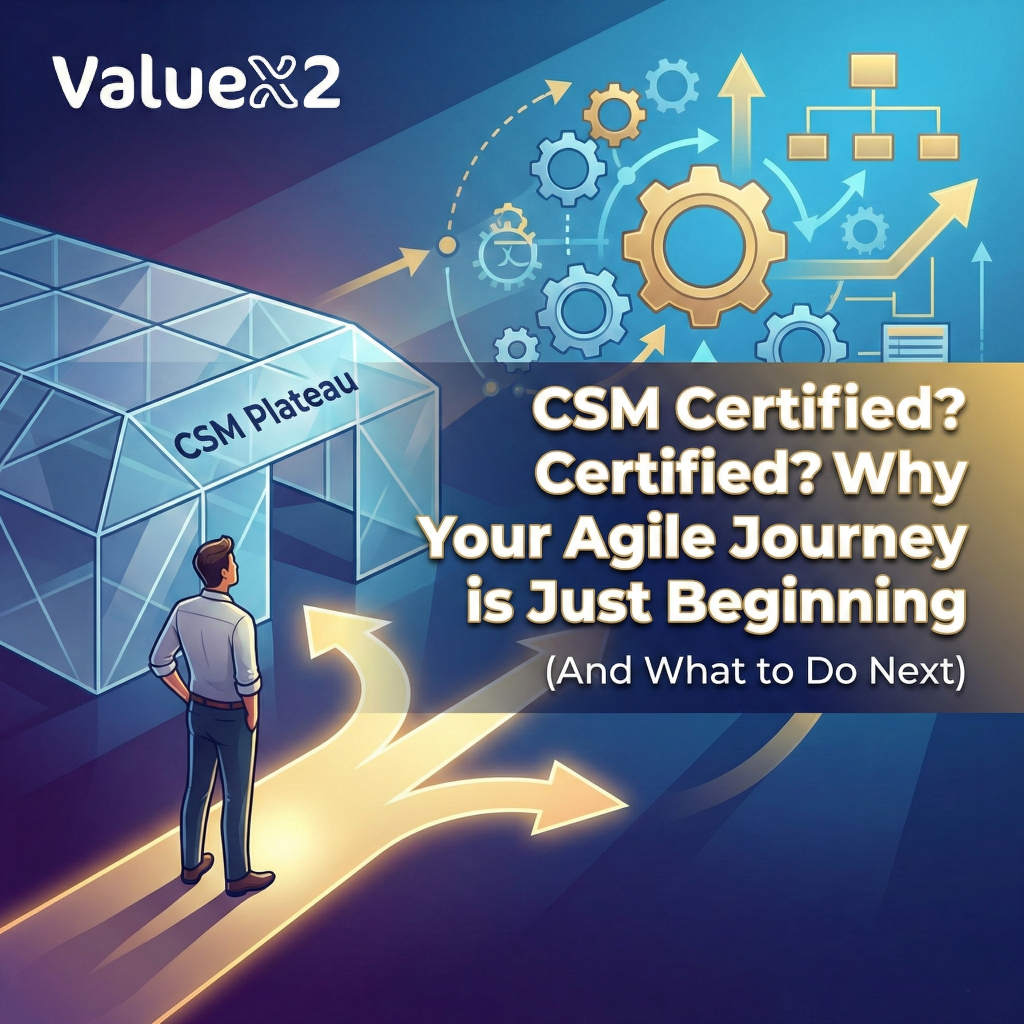 If you’re searching “CSM certified what next,” “best Scrum Master certification after CSM,” or “Scrum Master career path 2026 UK/Europe/US/Canada” – you’re not alone. Thousands of agile professionals hit this exact plateau every year.
You’ve mastered Scrum mechanics—daily standups, sprint planning, retrospectives. But you sense there’s a deeper level of organizational impact you haven’t accessed. Decisions crawl through approvals. Silos block value flow. Leadership demands “agility” while measuring output.
This guide reveals your optimal next steps. We’ll compare all major paths (ICP-BAF, PSM, SAFe, PMI-ACP, A-CSM) with exact career outcomes, salary data, and enterprise case studies. No fluff. Just the roadmap that moves you from team facilitator to enterprise influencer.
The CSM Plateau: What Your Certification Actually Delivers (And Doesn’t)
Let’s be honest about what the CSM certification provides. It’s an excellent foundation. You learn the Scrum framework, understand roles and ceremonies, and gain vocabulary to participate in agile conversations. For many, it’s their first structured exposure to iterative delivery and team facilitation.
But here’s what the two-day CSM course doesn’t—and realistically can’t—cover in depth:
- How organizations actually function as systems. The CSM focuses on team-level dynamics within a Scrum framework. It doesn’t address organizational bottlenecks, approval delays, or structural inefficiencies.
- The human side of transformation. You learn Scrum practices, but not how to help people navigate uncertainty, resistance, or mindset shifts.
- Strategic alignment beyond the team. You learn backlog management, but not how it connects to enterprise strategy or portfolio decisions.
Here’s what two-day CSM training skips:
| CSM Covers Well | CSM Doesn’t Cover |
|---|---|
| Sprint ceremonies | Why approvals kill sprint momentum |
| Product backlog mgmt | Portfolio alignment across business units |
| Team self-organization | Cross-department silos blocking value |
| Basic retrospectives | Resistance from fear/identity shifts |
This isn’t a criticism of the CSM—it’s simply a recognition of scope. The certification was designed to create competent team-level facilitators, not organizational transformation leaders.
The Invisible Ceiling
Career progression often stalls without a shift in capability. Entry-level Scrum Master roles are accessible, but advancement requires systems thinking, leadership influence, and organizational insight.
Career growth requires intentional positioning, not just effort. The moment hard work stops working is the moment leadership work begins.
What Senior Agile Roles Actually Require
Senior Scrum Masters, Agile Coaches, and Transformation Leads need different competencies, including:
- Systems thinking and organizational design
- Change management and resistance navigation
- Executive stakeholder engagement
- Strategic alignment and value optimization
- Coaching beyond individual teams
The Enterprise Agile Coach Difference
Enterprise Agile Coaches guide transformation across departments and leadership levels. Their responsibilities include:
- Assessing organizational readiness
- Designing transformation strategies
- Coaching executives
- Navigating organizational complexity
- Building sustainable agility
The Certification Landscape: Choosing Your Next Investment Wisely
Advanced Scrum Certifications (A-CSM, CSP-SM)
Deepens Scrum expertise and facilitation mastery.
Best for: Scrum specialists focused on team-level coaching.
SAFe Certifications
Focuses on scaling agile across large enterprises.
Best for: Professionals working in large organizations using SAFe.
PMI-ACP Certification
Provides broad agile knowledge across frameworks.
Best for: Project managers and PMO professionals.
ICAgile Business Agility Foundations (ICP-BAF)
This certification focuses on organizational agility, including:
- Systems thinking
- Organizational culture and structure
- Strategic alignment
- Change leadership
- Enterprise agility
Best for: Professionals seeking organizational impact and leadership roles.
Why Business Agility Foundations Changes the Trajectory
Frameworks are tools—not agility itself. Understanding underlying organizational principles allows you to work effectively across any framework.
What You’ll Actually Learn
- Systems thinking and organizational diagnosis
- Context-based decision-making
- Managing organizational tensions
- Constraint-based improvement strategies
- Stakeholder engagement techniques
- Human-centered change management
The Practical Application Difference
You will learn to:
- Analyze cross-functional challenges
- Identify systemic blockers
- Design transformation initiatives
- Map value streams
- Enable decentralized decision-making
Who Should Consider Business Agility Foundations
- Scrum Masters seeking deeper organizational understanding
- Professionals wanting influence beyond teams
- Aspiring Agile Coaches or transformation leaders
- Leaders supporting enterprise agility
- Professionals wanting to differentiate their career
The Career Impact: What Professionals Report
- Clarity: Better understanding of transformation challenges
- Credibility: Improved executive communication
- Career growth: Increased promotion opportunities
- Greater effectiveness: Ability to remove systemic constraints
Making Your Decision: Questions to Consider
- What level of impact do you want?
- What roles are you targeting long-term?
- What is currently limiting your effectiveness?
- How do you want to differentiate yourself?
The Path Forward
Your CSM certification was an important first step. But advancing into leadership requires developing organizational agility capabilities.
The ICAgile Business Agility Foundations certification helps you:
- Understand organizational systems
- Influence enterprise agility
- Advance into leadership roles
- Increase career opportunities and earning potential
Explore the ICAgile Business Agility Foundations Certification at ValueX2
Frequently Asked Questions
Is ICP-BAF recognized by employers?
Yes. It is globally recognized and valued for organizational agility expertise.
Are there prerequisites to do the Business Agility Foundations Certification?
No formal prerequisites, but agile experience is beneficial.
How is ICP-BAF different from SAFe?
SAFe teaches a framework. ICP-BAF teaches organizational agility principles applicable everywhere.
Is Business Agility Foundations only for IT professionals?
No. It applies to HR, marketing, operations, and leadership roles.
Does the Business Agility Foundations certification expire?
No. ICP-BAF is lifetime certification with no renewal requirements.
Is ICP-BAF harder than CSM?
No. CSM = ceremonies. ICP-BAF = case studies on org design. Expect systems analysis, not sprint math.
Ready to take the next step? Contact ValueX2 to learn more about upcoming training opportunities.

Bhavna is an Agile Coach and Consultant with 15+ years of experience in advisory, corporate finance, IT assurance, and operations at Big 4 and within the industry in the UK and India. She has recently been the CEO of a start-up where she implemented agile practices within HR, Marketing, and Product teams.
She is also a SAFe® Practice Consultant (SPC) and authorized instructor for ICAgile Agility in HR (ICP-AHR), Agility in Marketing (ICP-MKG), and Business Agility Foundations (ICP – BAF) training courses. She provides training for agile transformation to corporate, public, and private batches, as well as consulting for enterprise agile transformation.