Courses
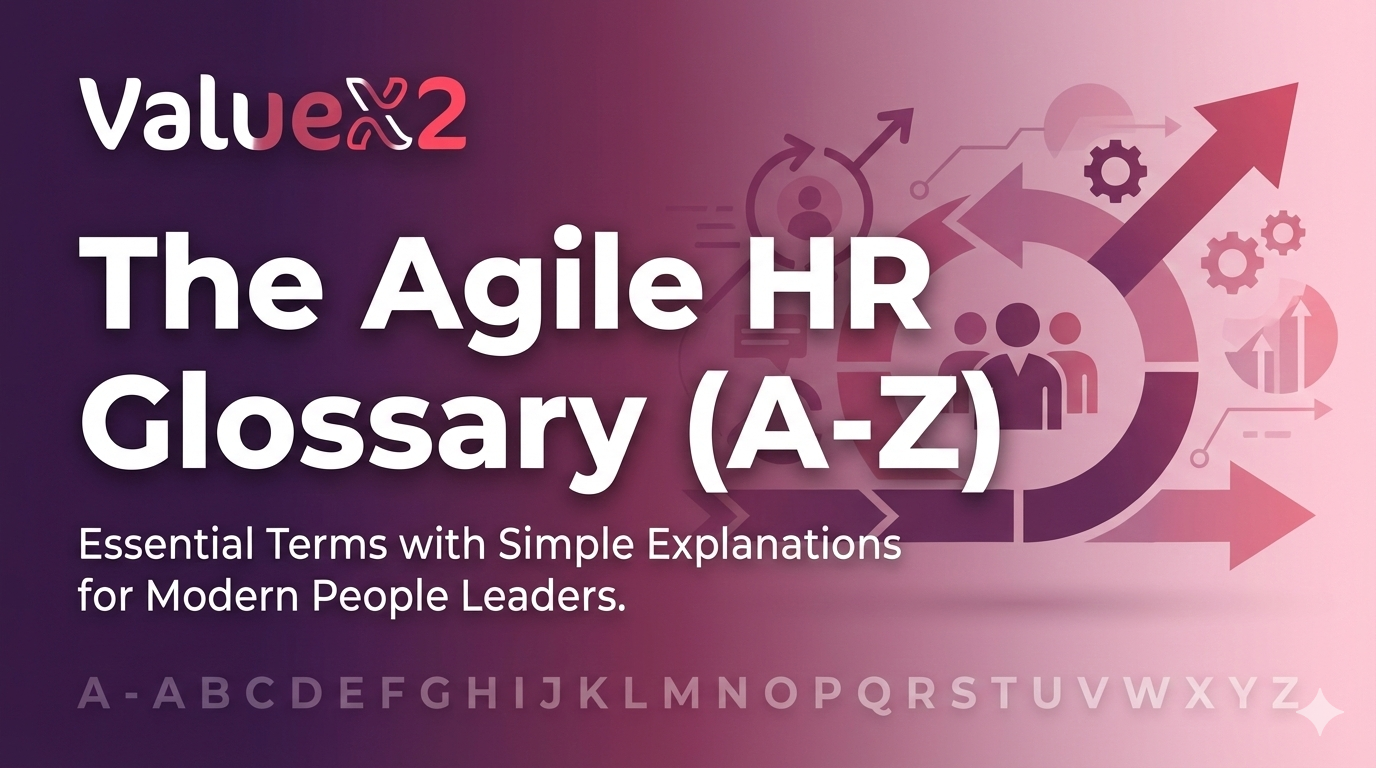
 A practical glossary for HR professionals new to Agile, grounded in real-world experience. We have also added ValueX2 perspective based on our extensive Agile HR Transformation experience.
 A
A
Agile
Agile is a mindset supported by new ways of working that prioritises learning, adaptability, and delivering value in small steps. In HR, Agile means moving away from long plans and big rollouts, and instead improving employee services through short cycles, feedback, and experimentation. This improves HR outcomes and makes them more employee-centric.
From a ValueX2 perspective, Agile only matters if it helps HR make better decisions faster — not if it adds new rituals without impact. Goal is to become proactive strategic partner to the business.
Agile HR
Agile HR applies Agile principles to people-related work such as recruitment, learning, performance, and organisation design. Agile HR is a way of working where HR teams focus on outcomes, learning, and adaptability rather than fixed plans and rigid processes. Instead of delivering large HR initiatives in one go, Agile HR works in short cycles, tests ideas early, and adjusts based on feedback from employees, managers, and the business.
In practice, Agile HR helps teams respond faster to changing workforce needs, reduce wasted effort, and stay closely aligned with business priorities. At ValueX2, Agile HR is less about adopting frameworks like Scrum or Kanban and more about building habits, mindset and culture that make HR work visibly valuable. This allows HR stay relevant in complex, fast-changing environments and AI-driven economy.
AI (Human-Centred in HR)
Human-centred AI means using technology to support people, not replace meaningful human judgement. In HR, this usually means automating repetitive tasks while protecting time for coaching, decision-making, and complex conversations.
Ethics, fairness, transparency, and employee experience are treated as success criteria, not afterthoughts.
Agentic AI (in HR)
Beyond simple automation, Agentic AI refers to AI systems that can autonomously execute complex HR tasks (like end-to-end candidate sourcing or personalized career pathing).
At ValueX2, we coach HR teams to treat these AI agents as “Digital Squad Members” that handle the heavy lifting of data, allowing humans to focus on high-empathy coaching.
HR Analytics
HR analytics is the use of data and statistical methods on HR and workforce information to improve people decisions and business outcomes.
HR Analytics is the practice of using data to understand what’s happening in the workforce and to make better decisions about people, work, and organisation performance.
In practice, HR Analytics is not about complex models or dashboards for their own sake. What I see work best is when HR teams start with a real question — Why are we losing people in certain roles? Where does hiring slow down? What’s actually driving engagement here? — and then use data to test assumptions and guide action.
From a ValueX2 perspective, HR Analytics only creates value when it leads to clear decisions or experiments. Simple metrics reviewed regularly with leaders usually outperform sophisticated analysis that never changes behaviour. The goal is insight that informs action, not reports that sit in a folder.
Autonomy
Autonomy refers to giving teams and individuals appropriate freedom to make decisions about how they work. In Agile HR, autonomy is balanced with clear goals and boundaries/guardrails so teams can adapt without chaos. This is critical for Agile Teams to respond to learning and feedback as received instead of waiting for bureaucratic approvals.
In practice, we see autonomy work best when HR also invests in clarity — about priorities, outcomes, and decision rights, leads to transparency.
B
Backlog (HR Backlog)
A backlog is a prioritised list of work that an HR team could do. It includes improvements, ideas, experiments, and known problems. A visible backlog helps HR make trade-offs clear and focus on what matters most.
We at ValueX2 suggest, that a healthy backlog makes trade-offs explicit. It helps HR teams say “not now” with clarity and ensures effort is focused on what matters most to the business and employees. Another top tip is teams should have only ONE backlog managed by one HR Product Owner.
Burnout
Burnout is chronic exhaustion caused by sustained overload and lack of recovery. Agile HR addresses burnout by managing work in smaller increments, limiting work in progress, and encouraging regular reflection on workload and ways of working.
From experience, burnout often shows up first in HR teams themselves — which makes Agile ways of working especially important internally.
C
Cadence
Cadence is the regular rhythm of work — for example, planning every two weeks or reviewing outcomes monthly. A steady cadence helps HR teams create predictability without rigid plans.
We often see HR teams regain confidence simply by introducing a reliable cadence they can actually sustain.
Change Fatigue
Change fatigue happens when employees experience too many changes too quickly, especially without clear benefits. Agile HR reduces change fatigue by breaking initiatives into smaller, testable steps.
At ValueX2, we treat people’s capacity as a real constraint, not an afterthought.
Continuous Improvement
Continuous improvement is the habit of regularly reflecting on what’s working and making small adjustments. In Agile HR, improvement is part of daily work, not a separate initiative.
The strongest HR teams don’t wait for transformation programs — they improve continuously.
Change as a Continuous Process
This mindset treats change as something that happens incrementally rather than through large, one-off initiatives. HR designs small interventions, gathers feedback, and adapts continuously.
This approach reduces change fatigue, protects people’s capacity, and increases the likelihood that change actually sticks. This approach consistently leads to better adoption and far less resistance.
D
Daily Stand-up (Daily Scrum)
A 15-minute daily synchronization meeting for the HR Squad. It’s not a status report for the boss; it’s a huddle for the team to identify “blockers” and align on the day’s priorities.
Data-Driven HR
Data-driven HR means using data to inform decisions — not replacing judgement, but strengthening it. Agile HR starts with simple metrics and regular conversations about what the data is telling you.
In practice, good questions matter more than perfect data.
Definition of Done
The Definition of Done clarifies when a piece of HR work is “good enough” to be considered complete. This prevents endless tweaking and helps teams deliver value sooner.
We often see HR teams stuck because “done” was never clearly agreed.
Dynamic Skills Mapping
Dynamic skills mapping focuses on understanding and updating the skills an organisation needs as work evolves — especially in response to AI, automation, and new business models.
Instead of static job descriptions, HR works with short review cycles and real data to understand how skills are changing and where to invest in development.
E
Employee Experience (EX)
Employee experience refers to how people experience work across moments that matter — from hiring to development to exit. Agile HR improves EX through ongoing feedback and incremental improvements.
At ValueX2, EX improves fastest when HR stops designing for averages and starts learning from real journeys.
Employee Experience (EX) Design
The practice of designing HR services as if they were consumer products. In Agile HR, we don’t just “launch” a performance management system; we use User Research to ensure it actually helps employees grow rather than just creating paperwork.
Experiment (HR Experiment)
An HR experiment is a small, low-risk change designed to test an assumption. Instead of rolling out a full policy or program, HR teams trial a change with a limited group, observe the impact, and decide what to do next. Agile HR uses experiments instead of large rollouts when uncertainty is high. This is the most important aspect required to be done when we want to have learning and feedback from our customers i.e. employees.
Experiments reduce fear because they make learning explicit.
Experiments are especially useful in areas like hybrid working, learning design, performance management, and AI adoption — where certainty is low and context matters.
F
Flow
Flow describes work moving smoothly without unnecessary delays or bottlenecks. Agile HR improves flow by limiting work in progress and focusing on finishing before starting new work.
Improving flow often delivers more value than adding capacity.
Feedback Loop
A feedback loop is a structured way of gathering input, acting on it, and reviewing the results after running an Agile HR experiment. Agile HR relies heavily on feedback loops with employees, managers, and leaders.
Without feedback loops, HR work quickly drifts away from real needs. Instead of waiting for an annual engagement survey, Agile HR uses “Micro-loops” (short surveys, focus groups, or data analytics) to pivot or persevere with a project.
G
Governance (Agile Governance)
Agile governance focuses on enabling good decisions rather than enforcing rigid controls. In HR, this often means clear principles, guardrails, and transparency instead of heavy approval layers.
This is especially important when dealing with AI, hybrid work, and fast-moving change.
Goals
Agile HR uses clear, outcome-focused goals rather than long task lists. Goals help teams prioritise work and adapt when conditions change.
From experience, fewer goals almost always lead to better results.
H
HR as a Product
Treating HR services “as products” means designing and improving them from the perspective of the people who use them — candidates, employees, managers, and leaders.
Recruitment, onboarding, performance management, learning, and workforce planning all have customers, outcomes, and trade-offs. When HR teams treat these services as products, they clarify ownership, prioritise improvements, and measure success based on real impact rather than activity or compliance. Employee-centricity which is equivalent of Customer-centricity is achieved.
At ValueX2 we leverage Design Thinking Principles to achieve this continuously.
HR Product Owner
An HR Product Owner is responsible for maximising the value of a specific HR service. This role focuses on outcomes, not administration.
In practice, an HR Product Owner:
- Clarifies what success looks like for the service
- Prioritises work based on business and employee needs
- Makes trade-off decisions when capacity is limited
- Works closely with stakeholders to gather feedback
This role helps HR move from reactive delivery to intentional value creation.
Hybrid Working
Hybrid working combines on-site and remote work. Agile HR treats hybrid models as evolving systems, refined through pilots and feedback rather than fixed policies.
This avoids locking in assumptions too early.
Hybrid Working Principles
Hybrid working principles are shared guidelines that help teams make consistent, fair decisions about where and how work happens.
Unlike rigid rules, principles provide direction while allowing teams to adapt to their context. They are usually refined through pilots and feedback loops rather than set once and enforced centrally.
HR Data Literacy
HR data literacy is the ability to understand, discuss, and use data in everyday decision-making — without needing advanced analytics skills.
It develops through regular review rhythms, shared metrics, and practical conversations about what the data means and what to try next.
I
Iteration
An iteration is a short cycle of work that produces learning or improvement. Agile HR relies on frequent iterations instead of waiting months to see results.
Iteration builds confidence because progress is visible and faster feedback is obtained reducing the risk of failures.
Incremental Change
Incremental change means improving in small steps rather than large transformations. This approach reduces risk and builds confidence over time.
It is one of the most underestimated strengths of Agile HR.
J
Job Design
Job design involves shaping roles, responsibilities, and expectations. Agile HR treats job design as dynamic, adjusting roles as work and skills evolve.
This is particularly important in AI-enabled environments.
K
Kanban for HR
Kanban is a visual way to manage work by showing tasks in stages (for example: To Do, In Progress, Done). Many HR teams use Kanban to improve transparency and flow by identifying bottlenecks in real-time. If there are 10 items in “Doing” but 0 in “Done,” the team knows they have a capacity issue.
It often works better than complex planning tools.
KPIs (Key Performance Indicators)
KPIs are metrics used to track performance. Agile HR uses a small number of meaningful KPIs tied to outcomes rather than activity.
More KPIs rarely lead to more insight.
L
Leading Indicators (in HR)
Leading indicators are early signals that show whether HR work is moving in the right direction. Examples include cycle time, adoption rates, or stakeholder satisfaction. Consider them as signals which will allow you to pivot, persevere or adapt your HR experiment to move in right direction while the experiment is still in momentum. Allows you to achieve the “outcome” not just deliver “output”.
They complement lagging indicators such as attrition or engagement scores and allow HR teams to adjust before problems become visible at scale.
Learning Sprint
A learning sprint is a short, focused period of learning aimed at building a specific skill that can be applied immediately in real work.
Learning sprints are practical, time-bound, and iterative. They replace large, generic training programs with smaller cycles that build confidence and capability over time.
This makes learning easier to absorb and apply.
Learning Agility
The ability for employees to rapidly unlearn old habits and acquire new skills. In an AI-driven market, ValueX2 views Learning Agility as the most valuable currency an employee can have. We use “Learning Sprints” to build this muscle across teams.
Lead Time
Lead time measures how long it takes for HR work to move from idea to impact. Shorter lead times usually indicate healthier HR systems.
Lead time is one of the most powerful — and underused — HR metrics.
M
Metrics
Metrics are measures used to understand performance and outcomes. Agile HR prioritises actionable metrics that support learning and decision-making.
If a metric doesn’t lead to a conversation, it’s usually not helping.
Minimum Viable Change
A minimum viable change is the smallest adjustment that can test an idea. This helps HR avoid over-designing solutions before learning what works.
This concept saves time, energy, and goodwill.
MVP (Minimum Viable Product) in HR
The simplest version of an HR initiative that can be released to gather feedback. For example, an MVP for a new learning program might be a single live workshop rather than a 10-module e-learning suite.
N
Needs-Based Prioritisation
Needs-based prioritisation focuses HR work on the most pressing employee or business needs rather than historical plans or seniority.
It often requires HR to say “not now” more clearly.
O
Org Agility
The ability of an entire company to sense and respond to change. HR is the “Operating System” for Org Agility—designing the structures, roles, and reward systems that allow the business to pivot when the market (or AI) shifts.
Outcome
An outcome is a measurable change in behaviour, performance, or experience. Agile HR focuses on outcomes rather than outputs.
This shift alone changes the quality of HR conversations.
Outcome-Based HR
Outcome-based HR focuses on results rather than activity. Instead of measuring success by how much HR delivers, teams track whether their work improves things like hiring speed, retention, engagement, or internal mobility.
This helps HR align more closely with business strategy and have more meaningful conversations with leaders about value.
OKRs (Objectives and Key Results)
OKRs are a goal-setting approach that connects ambitious objectives with measurable results. Some HR teams use OKRs to align work with strategy while staying flexible. This helps to achieve Aligned Autonomy.
They work best when treated as learning tools, not performance contracts.
P
Psychological Safety (In HR Teams)
Psychological safety is the shared belief that it’s safe to speak up, ask questions, and raise concerns without fear of blame. Without it, Retrospectives fail because people are afraid to speak the truth.
Agile HR fosters psychological safety to support learning and experimentation.
Without psychological safety, agility stays superficial.
Pivot or Persevere
A decision point in the Agile HR cycle after running a Agile HR Experimentation. After a Sprint Review, the HR Squad looks at the data, feedback and asks: “Is this working?” If yes, they persevere. If not, they pivot—changing the strategy without feeling like they “failed.”
This is the key difference between traditional large-scale HR rollouts vs experiment-led feedback driven value delivery.
Pilot
A pilot is a limited trial used to test a new approach before scaling. Agile HR uses pilots to reduce risk and build evidence.
Pilots create credibility where presentations don’t.
Q
Quarterly Review
A quarterly review is a regular checkpoint to reflect on outcomes, priorities, and learning. Agile HR uses reviews to adapt direction without constant re-planning.
This creates alignment without rigidity.
R
Retrospective (HR Retrospective)
An Agile Retrospective is one of the most critical elements of continuous improvement in an Agile HR team. It provides a structured, safe space for the team to pause, reflect, and improve its process. The goal is to make the team a high performing team.
Unlike post-mortems, retrospectives are regular and future-focused. HR teams use them to identify friction, improve collaboration, and adjust ways of working. Over time, retrospectives help build trust, psychological safety, and continuous improvement into HR’s daily practice.
Reskilling
Reskilling involves building new capabilities as work changes. Agile HR approaches reskilling incrementally, aligned to real business needs.
This reduces learning overload and increases relevance.
S
Scrum in HR
Scrum is a lightweight Agile framework that helps teams work together to deliver value in short, focused cycles called sprints.
When HR teams use Scrum, it’s not about copying software rituals. It’s about creating structure where there was previously ambiguity. Roles like Product Owner help clarify priorities, sprints create a regular rhythm, and reviews make HR work visible to stakeholders.
From experience at ValueX2, Scrum works best in HR when it’s adapted thoughtfully. Some teams use all the roles and ceremonies; others borrow just enough structure to improve focus, feedback, and delivery. The measure of success isn’t “doing Scrum properly” — it’s whether HR can learn faster, reduce rework, and deliver outcomes the business actually values.
Sprint (in HR)
A sprint is a short, time-boxed period — usually one to three weeks — during which an HR team focuses on delivering a small, meaningful improvement. This concept is borrowed from the Scrum Framework, where this timebox of 2-4 weeks makes the Scrum Team focus on making meaningful progress, to get feedback.
In HR, sprints are not about working faster for the sake of speed. They are about creating a regular rhythm for planning, testing, and learning.
Skills-Based Organization (SBO)
An SBO breaks down the “Job Title” silo and views the workforce as a Dynamic Skills Inventory. This allows HR to deploy people to the most critical projects based on what they can do, not what their title says.
Squad (HR Squad)
An HR squad is a small, cross-functional team formed to improve a specific outcome — such as reducing early attrition, improving manager capability, or speeding up hiring.
A typical HR squad includes HR practitioners, business representatives, and sometimes analytics or technology specialists. Squads work in short cycles, meet frequently, and regularly review progress with stakeholders. The goal is focus, learning, and visible impact.
At ValueX2 based on the context we work with HR teams to create HR Squad that might include a Recruiter, a Data Analyst, and a Business Leader. They are “empowered,” meaning they have the authority to make decisions without waiting for three levels of approval.
Stakeholder
A stakeholder is anyone affected by HR work, such as employees, managers, or leaders. Agile HR actively involves stakeholders throughout the work, not just at the end.
Early involvement reduces rework later.
T
T-Shaped HR Professional
An HR practitioner who has deep expertise in one area (the vertical bar of the T, e.g., Compensation) but also has broad skills in data, coaching, and agile facilitation (the horizontal bar). T-shaped people are the backbone of the AI-era HR department.
Transparency
Transparency means making work, priorities, and decisions visible. Agile HR uses transparency to build trust and alignment.
Transparency often removes the need for control.
Team Autonomy
Team autonomy allows teams to decide how best to achieve their goals within clear boundaries. Agile HR balances autonomy with shared principles.
Too much control kills learning; too little creates confusion.
U
Uncertainty
Uncertainty is a normal condition in complex environments. Agile HR accepts uncertainty and uses experimentation to learn rather than trying to predict everything upfront.
This is especially relevant in AI-driven change.
V
Value
Value in HR means improving outcomes for the business and employees. Agile HR measures value through impact, not activity.
From a ValueX2 perspective, value must be visible, measurable, and meaningful. It should be business outcome oriented keeping employee centricity in mind.
Value Stream
A value stream is the sequence of steps required to deliver value. In HR, this could be the end-to-end hiring or onboarding journey.
Mapping value streams often reveals hidden delays and waste.
Value Stream Mapping
A coaching exercise used by ValueX2 to visualize the flow of an HR process from start to finish. It helps identify “waste”—steps that add no value to the employee or the business—so they can be automated or eliminated.
Value Creation (ValueX2 Perspective)
From a ValueX2 perspective, value is created when HR work measurably improves outcomes for the business and the people within it.
This means focusing less on activity and compliance, and more on learning, impact, and adaptability — especially in complex, fast-changing environments.
W
Ways of Working
Ways of working describe how teams collaborate, make decisions, and manage work. Agile HR regularly revisits ways of working to keep them effective.
Good ways of working reduce friction and burnout.
Work in Progress (WIP)
Work in progress refers to tasks that have been started but not finished. Limiting WIP helps HR teams finish work faster and reduce overload.
This is one of the simplest ways to improve performance.
W — WIP Limits (Work in Progress Limits)
A strategy to prevent burnout. By setting a limit on how many projects the HR team can work on at once, we ensure that things actually get finished. The intention is to work on prioritised projects from the backlog that help achieve business goals. In Agile HR, we say: “Stop starting, start delivering.”
X
Cross-Functional Team
A cross-functional team includes people with different skills working toward a shared outcome. Agile HR relies on cross-functional collaboration to reduce handovers.
Cross-functional teams surface issues earlier.
Y
Yearly Planning (Agile Context)
Agile HR still plans annually, but treats plans as hypotheses rather than commitments. Regular reviews allow teams to adjust as priorities change.
This keeps strategy alive, not locked in.
Z
Zone of Control
The zone of control includes what an HR team can directly influence. Agile HR focuses experiments within this zone to drive meaningful change.
This prevents wasted effort and frustration.

Bhavna is an Agile Coach and Consultant with 15+ years of experience in advisory, corporate finance, IT assurance, and operations at Big 4 and within the industry in the UK and India. She has recently been the CEO of a start-up where she implemented agile practices within HR, Marketing, and Product teams.
She is also a SAFe® Practice Consultant (SPC) and authorized instructor for ICAgile Agility in HR (ICP-AHR), Agility in Marketing (ICP-MKG), and Business Agility Foundations (ICP – BAF) training courses. She provides training for agile transformation to corporate, public, and private batches, as well as consulting for enterprise agile transformation.