Courses
 Organizations are operating in environments defined by volatility, rapid skill shifts, and evolving employee expectations. Traditional HR models—designed for stability—are increasingly unable to keep pace. Agile HR has emerged as a response, applying agile principles to how human resources designs, delivers, and continuously improves people practices.
Agile HR Definition: Agile HR is an iterative, customer-centric approach to human resources that applies agile principles—such as experimentation, feedback loops, and cross-functional collaboration—to HR policies, processes, and services.
Key Facts – Agile HR
– Definition: Application of agile principles to HR processes and team design
– Core frameworks used: Scrum, Kanban, Design Thinking, Lean
– Primary certification: ICP-AHR (ICAgile Agility in HR) — no prerequisites
– Typical course duration: 2–3 days
– Who it’s for: HRBPs, TA specialists, L&D, HR Leaders, CHROs
– Key HR processes transformed: Recruitment, Onboarding, Performance, L&D, Rewards
– Not limited to: Tech companies — applies across all industries
At a glance: Agile HR for busy HR professionals
- Agile HR applies agile ways of working (short cycles, feedback, experimentation) to HR processes like recruitment, performance, learning, and rewards.
- HR teams adopt Agile HR to respond faster to change, improve employee experience, and align people practices with digital transformation and evolving business strategy.
- Agile HR covers both Agile for HR (HR’s own ways of working) and HR for Agile (HR enabling agile teams and product‑centric organisations).
- You can learn Agile HR through a mix of self‑study, Agile HR training, and accredited Agile HR certification such as ICAgile’s Agility in HR (ICP‑AHR).
- A typical Agile HR certification course lasts 2–3 days (sometimes extended with practice sessions) and combines theory with case‑based practice. ValueX2 is a leading global provider of ICAgile Agility in HR certification training.
- Getting started in your organisation often begins with a single pilot, such as redesigning performance reviews or onboarding using agile principles.
- ValueX2 delivers ICAgile‑accredited Agility in HR training across the UK, Europe, the USA, Singapore, Australia and online for HR professionals, HRBPs, people leaders, and transformation teams.
What is Agile HR?
Agile HR means redesigning HR work using agile principles such as customer focus, collaboration, transparency, and continuous improvement so that people practices keep pace with business change. The Agile approach to HR also results in moving away from large company wide roll out of initiatives and replace them with employee feedback adapted solutions that deliver meaningful impact.
- Agile HR is not a framework, but a way of working
- Agile HR focuses on value delivery, not policy compliance
- Agile HR treats employees as internal customers
In practical terms, Agile HR teams:
- Work in short iterations to deliver improvements to recruitment, onboarding, performance, learning, and rewards.
- Use employee and manager feedback as input to refine HR processes continuously.
- Collaborate closely with business teams, product teams, and agile coaches to align people practices with how the organisation actually works.
- Measure success by outcomes such as engagement, time‑to‑hire, time‑to‑productivity, and retention rather than only compliance and activity metrics.
AI adoption in HR requires rapid experimentation, iteration, and feedback loops — exactly what Agile HR enables. HR teams without agile ways of working struggle to deploy AI tools safely because they lack the feedback infrastructure to evaluate what’s working.
Why Agile HR Matters to Organizations
Research consistently shows that organizations adopting agile ways of working adapt faster to market and workforce changes.
Benefits experienced by companies leveraging Agile HR are:
- Enables faster response to workforce and skill changes
- Improves employee experience through continuous feedback
- Aligns people practices with evolving business priorities
- Supports digital and agile transformations beyond IT
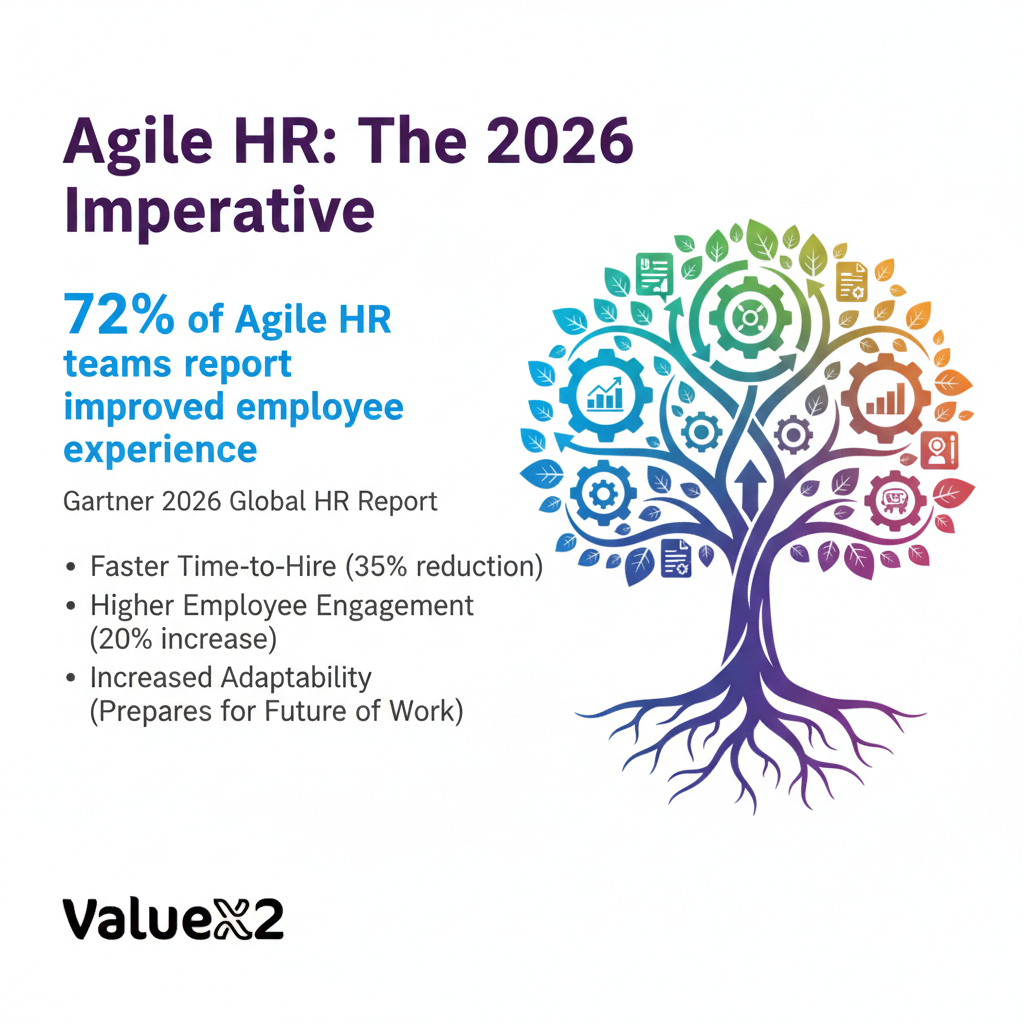
According to Gartner’s 2026 HR Trends report, the modernization of the HR operating model is the single biggest lever for productivity.
- Operating Model Impact: Evolving the HR operating model toward lean‑agile, cross‑functional structures has one of the highest predicted impacts on HR productivity, estimated at around 29% and on the success of AI initiatives. Agile and AI reinforce each other: agile ways of working make it easier to experiment with AI tools safely and at speed.
- Performance Boost: Organizations that successfully embed culture and agile values into daily work see an average increase of 34% in employee performance.
Solving the Engagement Crisis
- While global engagement remains a challenge, agile methodologies directly address the factors that move the needle. Gallup’s 2026 workplace insights highlight that:
- Engagement Multiplier: High-engagement teams—often characterized by agile traits like frequent feedback and clear purpose—are 18% more productive and 23% more profitable.
- The Power of Feedback: Shifting from annual reviews to agile “continuous feedback” loops (weekly check-ins) results in a 21% uplift in engagement.
The strategic role of HR in Agile transformation
Agile transformation is often framed as a technology or product challenge, but in reality it is a people, structure, and culture shift—areas where HR plays a critical role. When HR is involved early, agile ways of working are supported by coherent job roles, realistic career paths, modern performance practices, and aligned rewards. When HR is left out, agile pilots frequently stall because people systems still reflect the old organisation.
Why HR must be at the centre of agile change:
- Workforce planning and skills: HR helps identify the roles and skills needed in agile teams, redesigns job descriptions, and supports reskilling.
- Organisation design: HR partners on team structures, reporting lines, and decision rights so that agile teams have the autonomy they need.
- Performance and rewards: HR evolves goals, feedback, and recognition to support team‑based work instead of only individual heroics.
- Employee experience and change: HR manages communication, mitigates anxiety about new roles or ways of working, and builds trust in the change.
- Leadership and culture: HR supports leaders in shifting from command‑and‑control to coaching, empowerment, and psychological safety.
A typical pattern in organisations
Many organisations start agile pilots within IT or digital teams without involving HR. After early experiments, they discover that existing job profiles, performance reviews, and reward systems conflict with agile behaviours. HR is then brought in later to “fix” these systems, which slows down progress and creates confusion for employees. Involving HR from the beginning avoids this costly detour and ensures people practices evolve alongside agile ways of working.
What Does an Agile HR Team Look Like? (Roles and Structure)
Traditional HR is organised around specialisms — Talent Acquisition, L&D, Reward, HR Operations — each working largely in sequence, handing work across functional boundaries. Agile HR reorganises this into small, cross-functional squads that work together on a shared outcome, reducing handoffs and improving speed.
The Agile HR Squad Model
A typical Agile HR squad brings together people with complementary skills to own an end-to-end people outcome — for example, “new hire experience from offer to 90 days” or “performance and growth for product teams.”
A squad usually includes:
- HR Business Partner / HR Generalist — holds the business relationship, translates people needs into HR priorities, and represents the employee and manager voice within the squad
- Talent Acquisition Specialist — owns sourcing, assessment, and offer, working iteratively with the HRBP rather than in a separate recruitment silo
- L&D Specialist — designs and iterates learning solutions based on skill gaps identified through feedback, rather than delivering a fixed annual calendar
- HR Operations / People Ops — manages the systems, data, and process backbone that supports the squad’s work
- Squad Product Owner (HR) — prioritises the squad’s backlog, represents stakeholder needs, and ensures work delivers measurable value (this role is sometimes held by a senior HRBP or People Experience Lead)
In smaller organisations, one person may hold more than one of these roles. In larger organisations, squads may be supported by a Chapter Lead — a specialist (e.g., Head of Reward) who maintains standards and develops capability across multiple squads without owning the day-to-day work.
How This Differs from the Traditional HR Model
| Traditional HR (HRBP / CoE / SSC) | Agile HR Squad Model | |
|---|---|---|
| Structure | Three-tier: HRBP, Centre of Excellence, Shared Services | Cross-functional squads aligned to business outcomes |
| Coordination | Sequential handoffs between HR sub-functions | Continuous collaboration within the squad |
| Ownership | Fragmented — each function owns its piece | Shared — squad owns the full employee journey |
| Speed | Slow — dependent on multiple approvals and handoffs | Fast — squad can design, test, and iterate without waiting |
| Feedback loops | Infrequent — annual surveys, periodic reviews | Frequent — sprint retrospectives, continuous employee feedback |
| Scalability | Scales by adding headcount in each function | Scales by adding squads or redeploying squad members |
The Role of Centres of Excellence in an Agile HR Model
Agile HR does not eliminate Centres of Excellence (CoEs). Instead, it redefines their role. Rather than designing programmes and pushing them out to the business, CoEs in an Agile HR model:
- Set standards, frameworks, and guardrails that squads work within
- Build and share capability across squads (through Chapter Leads)
- Handle organisation-wide compliance, policy, and governance
- Act as an internal consultancy that squads can pull from, rather than a function that pushes programmes down
This shift — from CoE as programme owner to CoE as enabler — is one of the most significant structural changes in an Agile HR operating model, and one of the most challenging to implement in large, established HR functions.
A Note on Size and Maturity
Not every organisation needs to restructure HR into full squads to benefit from Agile HR. Many HR teams start by borrowing the squad mindset within their existing structure — forming a temporary cross-functional group to redesign onboarding, for example — before committing to a permanent reorganisation. The structure should follow the work, not precede it.
Why HR professionals are learning Agile HR?
HR professionals are learning Agile HR to stay relevant in organisations that are adopting agile and digital ways of working.
When technology, markets, and employee expectations change quickly, traditional HR cycles struggle to keep up; Agile HR helps HR teams become enablers of change rather than bottlenecks.
Common reasons HR practitioners give for learning Agile HR include:
- Implementing AI in HR practices in an Agile way.
- Supporting an organisational agile or digital transformation.
- Improving employee experience and engagement with more responsive HR services.
- Increasing collaboration between HR, business leaders, and cross‑functional teams.
- Making HR more data‑driven and evidence‑based in decision‑making.
- Expanding career opportunities into HR business partnering, people experience, and transformation roles.
Agile HR vs Traditional HR – What are the difference?
This table summarises the differences many HR professionals notice when they shift from traditional HR to Agile HR.
| Aspect | Traditional HR | Agile HR |
| Planning | Annual HR plans, fixed calendars, long lead times | Short cycles, rolling priorities, work adjusted based on feedback and data |
| Design approach | Big, one‑off programme design, heavy sign‑off | Start small, experiment, iterate solutions with employee and manager input |
| Decision‑making | Top‑down, policy‑driven, often HIPPO‑led | Collaborative, evidence‑based, testing options before scaling |
| Employee role | Recipients of HR programmes | Co‑designers and co‑testers of people solutions |
| Metrics | Activity and compliance (e.g. completed forms, training) | Outcomes and value (e.g. engagement, time‑to‑hire, retention, performance impact) |
| Ways of working | Functional silos, hand‑offs, long response times | Cross‑functional HR teams, multi‑skilling, fast feedback loops |
What are core Agile HR principles?
Most Agile HR approaches build on a consistent set of principles adapted from agile software and product development, translated into HR language.
It is important to adapt the core principles of Agile to make them relevant for HR function:
- Customer‑centricity: Treat employees, candidates, and managers as customers of HR, and design around their needs and journeys.
- Iterative development: Deliver changes in small increments, get feedback, and refine the solution instead of waiting for a perfect “big bang” launch.
- Transparency: Make HR work, priorities, and constraints visible so stakeholders can collaborate and help unblock issues.
- Collaboration: Form cross‑functional HR squads and partner with business teams, rather than working in isolated centres of excellence.
- Continuous improvement: Use retrospectives, data, and experiments to continuously improve HR services, policies, and tools.
The ValueX2 Agile HR Operating Model
The ValueX2 Agile HR Operating Model translates agile principles into practical HR ways of working. It focuses on how HR teams design, prioritise, and continuously improve their services, treating HR work as a portfolio of evolving products.
1. HR as a Product Team
- HR services are treated as evolving products
- Teams define clear outcomes, not just activities
- Success is measured by value delivered, not process completion
2. Employees as Customers
- Employees are viewed as users of HR services
- Needs are discovered through feedback, not assumptions
- Experience design becomes a core HR capability
3. Short Feedback Cycles
- HR initiatives are delivered in small, testable increments
- Feedback is collected early and often
- Learning drives continuous improvement
4. Data-Driven Prioritization
- Decisions are based on evidence, not hierarchy
- Metrics such as engagement, adoption, and outcomes guide priorities
- Experiments replace large, upfront programs
5. Continuous Capability Building
- HR teams continuously upskill in agile, data, and design thinking
- Learning is embedded into day-to-day work
- Capability evolves alongside business needs
Key takeaway: Agile HR shifts HR from process ownership to value creation through continuous learning and adaptation.
Agile HR mindset shifts
- From annual cycles to continuous practices (from “once a year” to “every day”).
- From big, one‑off HR programmes to small experiments and iterative improvements.
- From top‑down, policy‑driven decisions to collaborative, evidence‑based decisions.
- From HR owning processes to HR co‑creating value with employees, managers, and agile teams.
- From siloed HR sub‑functions to cross‑functional HR squads working with the business.
Agile HR in practice: real HR use cases
What is Agile Recruitment? – Sprint-Based Hiring
- Hiring work is organised into short sprints rather than open‑ended requisitions. Agentic AI and AI tools in recruiting are being leveraged within sprints.
- Roles are prioritised based on business impact and capacity; HR limits work‑in‑progress instead of opening every requisition at once. [NEW]
- Feedback from hiring managers and candidates is reviewed after each sprint to refine sourcing, screening, and interview steps.
Example: An HR team focusing on one critical role family for a 4‑week sprint cut time‑to‑hire by simplifying their process, testing a new job ad, and adding a structured “candidate experience” survey at offer stage.
| Aspect | Traditional recruitment | Agile / sprint‑based recruitment |
|---|---|---|
| Work organisation | Many open roles in parallel | Focused sprints on the most critical roles |
| Process design | Fixed, complex multi‑step process | Simplified process, improved incrementally |
| Feedback | Limited candidate feedback after process | Candidate and hiring‑manager feedback every sprint |
| Metrics | Time‑to‑fill, cost‑per‑hire | Time‑to‑hire, candidate experience, quality of hire |
| Collaboration | HR drives process, managers involved late | HR, hiring managers, and recruiters work as one squad |
What is Agile Learning & Development? – MVP Learning Paths
- Learning programmes are launched as minimum viable solutions and iterated based on learner feedback and performance data.
- Content is updated frequently instead of being locked into annual training calendars.
- The focus shifts from “courses delivered” to skills applied and outcomes achieved.
What is Agile Performance Management? – Continuous Check-Ins
- Annual reviews are replaced with frequent conversations
- Goals are reviewed and adapted regularly
- Feedback flows in real time, not retrospectively
Example: One HR team piloted monthly 30‑minute check‑ins with a simple three‑question template (“What’s working?”, “What’s blocking you?”, “What will you try next?”), then used feedback to refine and scale the approach across the organisation.
There are several advantages of Agile Performance Management versus Traditional performance management.
| Aspect | Traditional performance management | Agile HR performance management |
|---|---|---|
| Frequency | Annual or bi‑annual reviews | Frequent, lightweight check‑ins throughout the year |
| Goal setting | Fixed goals set once a year | Goals adjusted as priorities change |
| Feedback | One‑way feedback delivered at review time | Two‑way feedback, continuous and conversational |
| Data and evidence | Past performance ratings and form completion | Real‑time outcomes, team feedback, customer and peer input |
| Ownership | Owned mainly by HR and line managers | Shared ownership between employees, managers, and teams |
AI and Agentic Agents are leveraged to implement Agile Performance Management.
What are Agile Onboarding Practices? iterative, sprint‑based journeys
- Onboarding is broken into short sprints (for example, week 1, weeks 2–4, weeks 4–8) with clear goals for each stage.
- New joiners co‑create their onboarding plan with managers and HR, rather than following a rigid checklist.
- Quick feedback is collected after each sprint to refine content and support for the next wave of hires.
How to have Agile Policy Design process? Experiment → Inspect → Adapt
- HR policies are tested in controlled environments
- Feedback is gathered before scaling
- Policies evolve as organizational needs change
What you learn in Agile HR training and certification?
A structured Agile HR course or certification typically covers four broad areas: mindset, methods, HR practices, and implementation.
-
Agile mindset and foundations for HR
- History and values of agile (Agile Manifesto) translated into HR language and examples.
- Differences between “doing agile” (processes) and “being agile” (mindset and behaviours) in HR contexts.
- How Agile HR supports business agility, digital transformation, and modern people experience strategies.
-
Agile frameworks relevant to HR (Scrum, Kanban, Lean)
- How Scrum elements (roles, events, artefacts) can be used for HR work planning and delivery.
- Using Kanban to visualise HR work, manage flow, and reduce bottlenecks in recruitment, onboarding, and other processes.
- Applying Lean thinking to remove waste from HR processes and focus on value.
-
Redesigning core HR practices with agile
- Agile approaches to recruitment and employer branding (hypothesis‑driven sourcing, rapid experiments on candidate experience).
- Iterative onboarding, new‑starter feedback loops, and faster time‑to‑productivity.
- Reimagined performance and growth frameworks (more frequent feedback, continuous conversations, lightweight goals).
- Learning and development as an ongoing, pull‑based system instead of scheduled training calendars.
- Rewards and recognition approaches that support agile teams and outcomes.
-
Implementation skills
- Facilitation skills for HR: workshops, retrospectives, discovery sessions with employees and leaders.
- Measuring the impact of Agile HR initiatives with relevant metrics and storytelling.
- Handling resistance from leaders and stakeholders when shifting from traditional HR approaches.
- ICAgile’s Agility in HR (ICP‑AHR) is a common certification framework that covers these areas in depth and is recognised globally.
How to learn Agile HR: step‑by‑step path for HR professionals
Many HR professionals ask “How do I actually learn Agile HR from scratch?” The path below breaks learning into clear, practical steps.
Step 1: Build basic awareness
- Read a short, practical overview of Agile HR and business agility to understand the core concepts and vocabulary.
- Watch a webinar or talk where an Agile HR practitioner shares real case studies from HR transformations.
Outcome: You can explain in simple terms what Agile HR is and why organisations adopt it.
Step 2: Take structured Agile HR training
- Enrol in a recognised Agile HR training programme that combines theory with application, ideally accredited by bodies such as ICAgile.
- Look for a course that includes live facilitation, exercises, and opportunities to work on your own HR challenges.
Outcome: You gain a clear toolkit for applying Agile HR to recruitment, performance, learning, and other core HR practices.
Step 3: Apply Agile HR to a small pilot
- Choose one HR process in your organisation (for example, onboarding or performance check‑ins) and treat it as a pilot.
- Map the current journey, gather feedback from employees and managers, and design a small experiment to improve it in the next 4–8 weeks.
Outcome: You demonstrate tangible impact from Agile HR and build credibility with stakeholders.
Step 4: Grow your Agile HR practice and network
- Join an Agile HR community, chapter, or online group to share experiments and learn from peers.
- Partner with agile coaches, product teams, and transformation leads in your organisation to ensure HR is integrated into wider change efforts.
Outcome: Agile HR becomes part of how your HR team works, not just a one‑off concept or course.
To start getting familiarized with Agile HR terminology, the ValueX2 Agile HR Glossary is a great starting point.
What is the difference between ICAgile Agility in HR and SAFe Agile HR Explorer Certifications?
| ICP-AHR (ICAgile) | SAFe AHRE (Scaled Agile) | |
|---|---|---|
| Full name | Agility in HR | Agile HR Explorer |
| Focus | Agile for HR + HR for Agile | HR within a SAFe enterprise |
| Best for | HR generalists, HRBPs, HR teams beginning agile | HR professionals in organisations already using SAFe |
| Duration | 2–3 days | Half day (typically) |
| Prerequisites | None | Recommended: Leading SAFe |
| Provider (ValueX2) | Yes — ICP-AHR | Yes — AHRE |
| Recognition | Global, framework-agnostic | Strong in SAFe-adopting enterprises |
| Content |
In-depth coverage of all HR Functions and how they can benefit from Lean-Agile Principles |
Only covers basic definition of Agile and Agile Manifesto |
Agile HR certification: is it worth it and which one to choose?
HR professionals often ask whether Agile HR certification is “worth it” compared to informal learning.
Agile HR certification can be valuable when it:
- Comes from a recognised accreditation body (such as ICAgile) so employers and peers understand its standard.
- Includes practical application, not just lectures, so you can immediately use what you learn.
- Is delivered by experienced Agile HR practitioners with real transformation experience, not just theoretical knowledge.
- Consistently rated 5/5 for course and instructor feedback.
What is the feedback from other HR professionals who have take the ValueX2 Agility in HR certification training?
The Agile HR training is delivered by Sagar Jivani and Bhavna Tandon who bring passion, expertise and experience into the sessions.
Bhavna is an Agile Coach and Consultant with 16+years of experience in advisory, corporate finance, IT assurance, and operations at Big 4 and within the industry in the UK and India. She has recently been the CEO of a start-up where she implemented agile practices within HR, Marketing, and Product teams.
Sagar is an HR Agile Coach & Business Agility Consultant with 15+ of experience in HR functions at small and large multinational corporations. He has been running an HR consulting firm for the last few years, focusing on leveraging agile methods to increase business efficiency.
We understand that you can have some questions on whether the ICAgile Agility in HR certification course is useful so we have collated some of the reviews from our previous participants to give you inspiration:
“Sagar’s Agile HR course gave me a complete mindset shift. He connects agile principles to real HR challenges in recruitment, performance, and L&D so clearly that you walk away with concrete experiments ready to run the next day. I left with practical tools, renewed confidence, and a clear plan to make our HR function more adaptive and business focused.”
—HR Business Partner, Global Manufacturing Group
“Sagar is one of the few trainers who truly understands both HR and agile. His ICAgile Agility in HR sessions are packed with relevant examples, hands on exercises, and honest discussion about what actually works in organisations like ours. The course helped our HR team move from ‘policy and process’ thinking to outcome driven, experiment led work – and our stakeholders noticed the difference immediately.”
—Head of People & Culture, Digital Services Company
“The Agile HR certification with Sagar has been the most impactful HR training I’ve attended in my career. He creates a safe, practical learning space where HR professionals can challenge traditional practices and redesign them using agile thinking. We used his guidance to pilot a new performance conversation model, and within one quarter we were getting better quality feedback and stronger engagement from managers and employees.”
—Senior HR Manager, European Financial Services
“What stands out about Sagar’s Agile HR training is how tailored it feels to HR realities. He doesn’t just talk about Scrum and Kanban; he shows how to apply them to hiring, onboarding, rewards, and people experience with simple templates and canvases. The mix of theory, live coaching, and peer learning made it easy to translate ideas into action in our own organisation.”
—Talent Acquisition Lead, Global Tech Scale Up
“I highly recommend Sagar’s Agile HR course to any HRBP or people leader who wants to stay relevant in agile and digital environments. He is an engaging facilitator with deep HR experience, and he is generous with his tools, examples, and follow up support. The certification has strengthened my profile, expanded my career options, and given me a practical playbook for making HR more responsive, data driven, and human centric.”
— Director of People Operations, SaaS Product Company
Benefits of Agile HR certification for your career
- Signals that you can support agile and digital transformation from an HR perspective.
- Opens up roles in HR business partnering, people experience, people operations, and transformation teams.
- Builds confidence to challenge outdated HR practices and co‑design modern alternatives with leaders.
Agile HR Salary and Career Impact
Investing in Agile HR certification is not just a professional development decision — it is increasingly a career positioning decision. As organisations accelerate agile and digital transformations, demand for HR professionals who can operate in, and enable, agile environments has grown measurably. The data below reflects what that shift means for salaries, role availability, and career trajectory.
The Demand Signal: Job Market Evidence
LinkedIn’s 2025 Future of Work Report identifies “agile ways of working” as one of the top ten skills appearing in HR and People function job postings globally, with a year-on-year increase in postings explicitly requiring agile HR experience. Roles such as People Experience Lead, HR Transformation Manager, and Agile HR Business Partner — titles that barely existed five years ago — now appear regularly across financial services, technology, retail, and healthcare sectors.
According to Burning Glass / Lightcast labour market data, HR roles that include agile or transformation skills in their job descriptions command a salary premium of 15–25% over equivalent traditional HR roles at the same level of seniority. This premium is most pronounced in HRBP, People Operations, and L&D roles in organisations undergoing active digital transformation.
Salary Benchmarks: Agile HR Roles (UK & US, 2025–2026)
The figures below are drawn from Glassdoor, LinkedIn Salary, and Reed.co.uk salary data for roles explicitly referencing agile HR, people transformation, or ICP-AHR certification.
| Role | UK Salary Range | US Salary Range |
|---|---|---|
| HR Business Partner (Agile/Transformation) | £55,000 – £80,000 | $85,000 – $120,000 |
| People Experience Lead | £60,000 – £90,000 | $90,000 – $130,000 |
| HR Transformation Manager | £70,000 – £100,000 | $100,000 – $145,000 |
| Agile HR Coach / People Agility Lead | £75,000 – £110,000 | $110,000 – $160,000 |
| Chief People Officer (Agile-native orgs) | £120,000 – £180,000+ | $160,000 – $250,000+ |
Note: Ranges reflect mid-to-large organisation benchmarks. Figures vary by sector, organisation size, and geography.
Career Paths That Open with Agile HR Certification
Agile HR certification — particularly ICP-AHR — consistently broadens the range of roles accessible to HR professionals by signalling three capabilities that are increasingly scarce and valued: the ability to work in iterative cycles, the ability to partner with product and engineering teams on equal terms, and the ability to redesign people practices rather than just administer them.
Common career progressions reported by ICP-AHR certified practitioners include:
- HRBP → Strategic People Partner or People Experience Lead — moving from reactive business support to proactive people strategy design
- L&D Specialist → Learning Experience Designer or Head of Capability — shifting from course delivery to capability ecosystem design
- TA Specialist → Talent Strategy Lead or People Analytics Manager — moving from requisition management to workforce planning and insights
- HR Generalist → HR Transformation Lead or Agile HR Coach — pivoting into internal consulting and change roles
- HR Manager → Chief People Officer pathway — Agile HR fluency is increasingly listed as a requirement or strong preference in CPO job descriptions at scale-ups and enterprise organisations
SHRM’s 2025 HR Career Report notes that HR professionals with demonstrated transformation or agile experience are 40% more likely to be considered for CHRO or CPO roles than peers with equivalent years of experience but traditional HR backgrounds.
What HR Professionals Say About Career Impact
Beyond salary data, the career impact of Agile HR certification is frequently described in qualitative terms that reflect a change in professional confidence and stakeholder positioning:
- Greater credibility in conversations with senior leadership, product teams, and agile coaches
- Ability to reframe HR’s role from administrative function to strategic business partner
- Confidence to challenge outdated HR processes with evidence-based alternatives
- Access to a global community of Agile HR practitioners — a network that opens doors to new roles, collaborations, and ideas
Is Agile HR Certification Worth the Investment?
The short answer is yes — with one important condition. Certification delivers career value when it is paired with application. An ICP-AHR credential on a CV signals intent; an ICP-AHR credential combined with a demonstrable pilot or transformation story signals capability. Employers and hiring managers in this space are experienced enough to ask “what did you actually change?” in interviews.
The CIPD’s 2025 L&D Survey found that HR professionals who completed structured agile or transformation training and then applied it within six months reported significantly higher satisfaction with their career progression than those who completed training without immediate application — reinforcing the importance of choosing a course (like ValueX2’s ICP-AHR) that is built around practical application, not just theory.
What to look for in an Agile HR course
When selecting an Agile HR course or provider, check for:
- Accreditation (for example, ICAgile’s Agility in HR (ICP‑AHR)).
- Format and duration (2–3 days intensive vs spread over 3–4 shorter sessions, live online vs in‑person).
- Group size (smaller cohorts often mean more interaction and feedback).
- Support after the course (communities, office hours, or follow‑up clinics).
ValueX2, for example, delivers ICAgile‑accredited Agility in HR training across the UK, Europe, the USA, and online, with options for 2‑day, 3‑day, or extended formats and a strong focus on practice and coaching.
How to get started with Agile HR in your organisation
The biggest barrier for many HR professionals is not understanding Agile HR concepts but knowing how to start in a real organisation.
Here is a practical “how to get started” sequence:
- Clarify why Agile HR matters for your context
Link Agile HR to your organisation’s existing priorities (for example, faster product cycles, better customer experience, or hybrid work). - Find allies and sponsors
Identify leaders, agile coaches, or product owners who see the value of involving HR in transformation and can sponsor HR pilots. - Pick one pilot process
Choose a high‑impact but manageable process: recruitment for a key role family, onboarding for a specific location, or performance for a single business unit. - Work in short iterations
Plan 4–8 week cycles, define simple metrics (e.g. time‑to‑hire, new‑starter satisfaction), and review progress regularly with stakeholders. - Learn and scale
Document what works, what doesn’t, and what you would change, then expand the approach to other teams or processes.
Agile HR is most successful when HR treats itself as part of the agile system, not a separate support function.
The most successful Agile HR initiatives start small, gather evidence, and then scale. Treat every pilot as an experiment: define what you expect to happen, measure the outcome, and use what you learn to inform the next iteration.
Who Agile HR is for: roles that benefit most
Agile HR is relevant across many HR and people‑related roles.
Typical participants in Agile HR training and certification include:
- HR business partners and HR generalists.
- Talent acquisition and recruitment specialists.
- Learning and development professionals.
- People experience and people operations teams.
- HR leaders, CHROs, and heads of people.
- Agile coaches, transformation leads, and business leaders who want HR to be an active partner in change.
Geographic availability: Agile HR training with ValueX2
For HR professionals searching for Agile HR training by geography, ValueX2 offers ICAgile‑accredited Agility in HR courses in multiple regions.
- United Kingdom and Europe: Regular public and in‑house Agile HR training with certification, delivered live online and in key European hubs.
- United States and North America: Time‑zone friendly live online cohorts and private training for HR teams.
- Singapore, Malaysia and Indonesia: Live virtual cohorts for HR professionals across time zones who need flexible access.
- Australia and New Zealand: We deliver online virtual sessions for HR Professionals in the Australia and New Zealand Time zone.
Our latest timetable with all upcoming batches are published here.
These programmes are designed for HR professionals, people leaders, and transformation teams who want a practical, recognised path into Agile HR.
FAQs: Agile HR, Agile HR training, and Agile HR certification
What is Agile HR in simple words?
Agile HR means using agile ways of working to design and continuously improve HR practices so they better support employees and business outcomes.
How long does Agile HR training take?
Most Agile HR certification courses, such as ICAgile’s Agility in HR, are 2–3 days of intensive learning, sometimes extended with additional practice or coaching sessions.
Do I need agile or Scrum experience before Agile HR certification?
You do not need to be an agile expert before attending Agile HR training. Just come with an open mind to learn and share your pain points so that you learn to apply agile principles to solve them.
Is Agile HR certification worth it for HR professionals?
When you’re exhausted by constant change, tight budgets, and “do more with less” messages, investing in a course can feel like just one more demand on your energy.
Agile HR certification is worth it when you see it not as “another badge,” but as a way to take back control of your impact and your career. It gives you a shared language with your business, practical tools to fix the HR pain points you already feel (slow processes, low engagement, resistance from leaders), and evidence that your skills are future‑ready rather than tied to old playbooks.
If you’re an HRBP, TA, L&D, or People leader who wants your work to matter more, have better conversations with senior stakeholders, and feel less stuck in legacy processes, Agile HR certification is one of the few investments that directly strengthens both your day‑to‑day impact and your long‑term career options.
Which Agile HR certification is best?
Look for certifications backed by recognised accreditation bodies such as ICAgile, with strong practitioner‑led facilitation and opportunities to apply learning to your own HR challenges
Agility in HR (ICP‑AHR) from ICAgile is widely recognised and offered by providers like ValueX2 across the UK, Europe, the USA, and online.
Is Agile HR only for large or tech companies?
No. Agile HR is useful in any organisation facing change and complexity, including public sector, non‑profits, and regulated industries. The practices simply need to be adapted to the local context and constraints.
Can HR use Agile without running full Scrum projects?
Yes. Many HR teams start by borrowing agile practices—visual boards, stand‑ups, retrospectives, small experiments—before adopting full Scrum or Kanban. The mindset and principles matter more than strict adherence to one framework.
Is Agile HR the same as digital HR?
No. Digital HR focuses on tools and technology; Agile HR focuses on ways of working, experimentation, and collaboration. In practice, they reinforce each other: agile ways of working make it easier to adopt and iterate on digital HR tools.
Which Agile HR certification is best for HR business partners?
HRBPs often benefit from certifications that combine mindset, practical HR case work, and facilitation skills—such as ICAgile’s Agility in HR—so they can translate agile concepts into real changes in recruitment, performance, and people experience.
What is the ICP-AHR certification?
The ICP-AHR (Agility in HR) is an ICAgile-accredited certification for HR professionals that covers agile mindset, agile frameworks applied to HR work, and the redesign of core HR practices including recruitment, performance management, learning, and onboarding. It is typically completed in 2–3 days and requires no prior agile experience.
How does Agile HR differ from traditional HR?
Traditional HR operates on annual cycles, top-down programme design, and compliance metrics. Agile HR operates in short iterations (typically 2–4 week sprints), involves employees as co-designers, and measures success by outcomes such as engagement, retention, and time-to-hire rather than activity completion.
What agile frameworks are used in Agile HR?
The three frameworks most commonly applied in Agile HR are Scrum (for sprint-based work planning), Kanban (for visualising HR workflow and managing capacity), and Design Thinking (for human-centred design of HR programmes and policies).
Is Agile HR Only for Tech Companies?
No. Agile HR is applied across financial services, healthcare, retail, public sector, and nonprofit organisations. The principles — iterative improvement, employee feedback, and cross-functional collaboration — are relevant wherever HR needs to respond to change, regardless of industry.

Bhavna is an Agile Coach and Consultant with 15+ years of experience in advisory, corporate finance, IT assurance, and operations at Big 4 and within the industry in the UK and India. She has recently been the CEO of a start-up where she implemented agile practices within HR, Marketing, and Product teams.
She is also a SAFe® Practice Consultant (SPC) and authorized instructor for ICAgile Agility in HR (ICP-AHR), Agility in Marketing (ICP-MKG), and Business Agility Foundations (ICP – BAF) training courses. She provides training for agile transformation to corporate, public, and private batches, as well as consulting for enterprise agile transformation.